- 15.09.2026
- News
Second-hand smoke: 2.7 billion people worldwide are still exposed
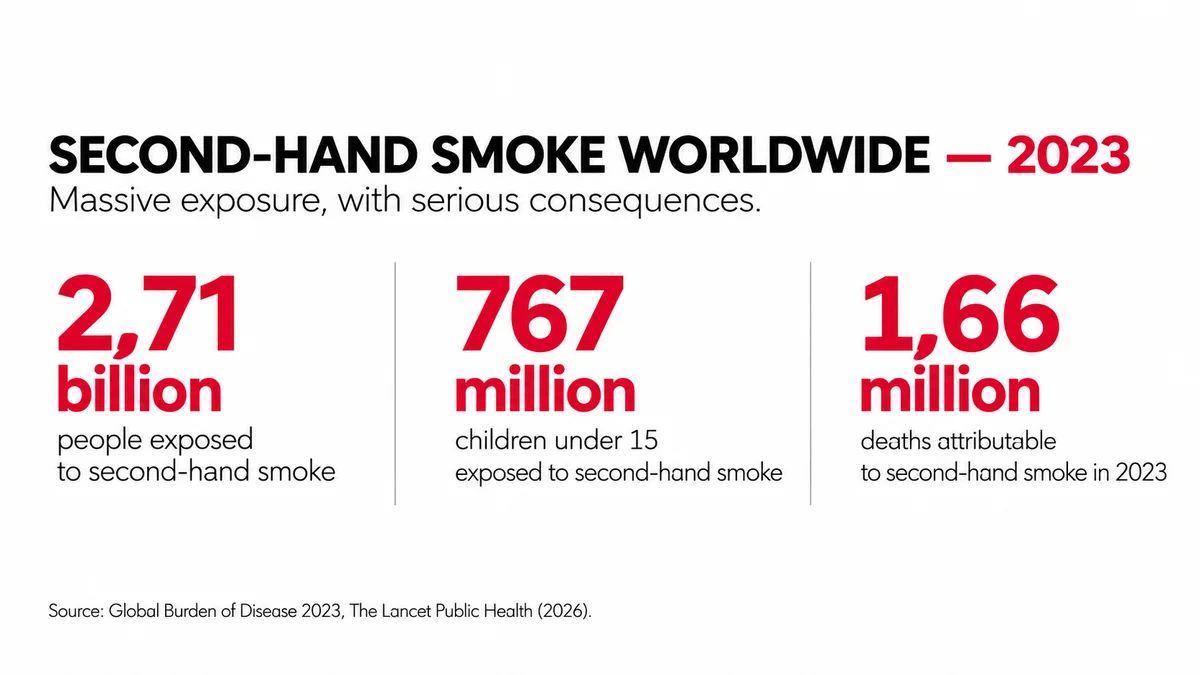
Despite the progress made since 1990, exposure to second-hand smoke remains a major public health issue. A new analysis published in The Lancet Public Health estimates that 2.71 billion people worldwide were still exposed to second-hand smoke in 2023. Among them were 767 million children under the age of 15.
The scale of the problem remains considerable. According to a new study from the Global Burden of Disease (GBD) 2023, published in The Lancet Public Health in September 2026, more than one third of the world’s population is still exposed to second-hand smoke.
Researchers analysed trends in exposure across 204 countries and territories between 1990 and 2023. This is the first GBD publication specifically dedicated to the prevalence of second-hand smoke and its consequences for health.
A decline that is not enough
Since 1990, the global age-standardised prevalence of exposure has fallen by 22.2%. Yet this positive trend masks a worrying reality: due in part to population growth, the total number of people exposed has not decreased worldwide.
In some regions, it has increased sharply. Between 1990 and 2023, the number of people exposed almost doubled in sub-Saharan Africa (+98.5%) and rose by 72.1% in North Africa and the Middle East.
Children remain particularly affected. In 2023, an estimated 767 million children aged 0–14 were exposed to second-hand smoke.
1.66 million deaths in a single year
The health consequences are substantial. In 2023 alone, researchers attributed approximately 1.66 million deaths worldwide to second-hand smoke, along with 44.8 million healthy years of life lost to illness, disability or premature death (DALYs).
Ischaemic heart disease accounts for the largest share of this health burden in the overall population. Among children, lower respiratory infections account for the greatest burden.
Overall, the study assesses risks associated with nine health conditions. Asthma is now also included in the Global Burden of Disease estimates.
Better protection in public spaces and at home
According to the authors, the progress achieved over the past three decades should not obscure the fact that exposure remains widespread. Major geographical disparities persist and, in some countries, women are considerably more exposed than men.
The researchers call for faster implementation and enforcement of comprehensive tobacco control measures, with particular emphasis on protecting women and children. This protection is not limited to public places: exposure in the home also remains a key concern.
The findings are therefore a reminder that second-hand smoke is not simply a matter of individual tobacco use. It also affects people who do not smoke and who may be involuntarily exposed in their everyday environment.
And Switzerland? Legislation has barely evolved since 2010
In Switzerland, protection against second-hand smoke still relies largely on the federal law that came into force in 2010. It prohibits smoking in enclosed spaces that are accessible to the public or serve as workplaces for more than one person, including restaurants, schools, hospitals, public transport and shared offices. However, the law provides for several exceptions, including designated smoking rooms and certain smoking establishments.
Since then, the federal framework has seen no significant development that would substantially extend protection for the population. Since October 2024, the ban has also applied to electronic cigarettes and heated tobacco products in the places covered by the law. Significant gaps nevertheless remain.
Federal legislation continues to focus primarily on indoor spaces. It does not provide general protection against second-hand smoke outdoors, for example at public transport stops, on certain terraces or near building entrances. Nor does it provide specific protection when smoke from others enters a private home from a neighbouring apartment, balcony or shared area.
Swiss Association for Tobacco Control calls for better protection against second-hand smoke
For the Swiss Association for Tobacco Control, the new data published in The Lancet Public Health are a reminder that second-hand smoke is not solely a matter of individual behaviour: protecting people from involuntary exposure is a public health responsibility.
Switzerland needs to strengthen its legislation and provide better protection in places where exposure cannot reasonably be avoided. Particular attention must be paid to children, who can neither choose their environment nor remove themselves from adults’ smoke.
Protection must also reflect changing patterns of consumption. Electronic cigarettes and heated tobacco products also emit aerosols containing potentially harmful substances and should be consistently included in protective measures.
Alongside its policy work, the Swiss Association for Tobacco Control has developed passivesmoke.ch, a national platform dedicated to second-hand smoke. Available in several languages, it provides scientific and legal information as well as practical guidance for people affected by second-hand smoke, particularly in their own homes.
More than 15 years after the federal law came into force, scientific knowledge has advanced and products have evolved. Protection of the Swiss population from second-hand smoke must now evolve as well.
Find out more
scientific and legal information, practical advice and guidance for people exposed to second-hand smoke.