- 19.10.2026
- News
Germany significantly increases cigarette taxes and Switzerland continues to stand still
While Germany has just approved substantial, progressive increases in tobacco taxation through 2030, Switzerland has not increased its cigarette excise tax since 2013. One of the arguments repeatedly used to justify this inaction — cigarette price differences with neighbouring countries — is now becoming even less convincing. It is high time for Switzerland to once again use taxation as an effective instrument of tobacco control.
On 15 and 16 October 2026, the German Bundestag and Bundesrat approved a major reform of tobacco taxation. Starting in January 2027, tobacco taxes will increase progressively each year until 2030.
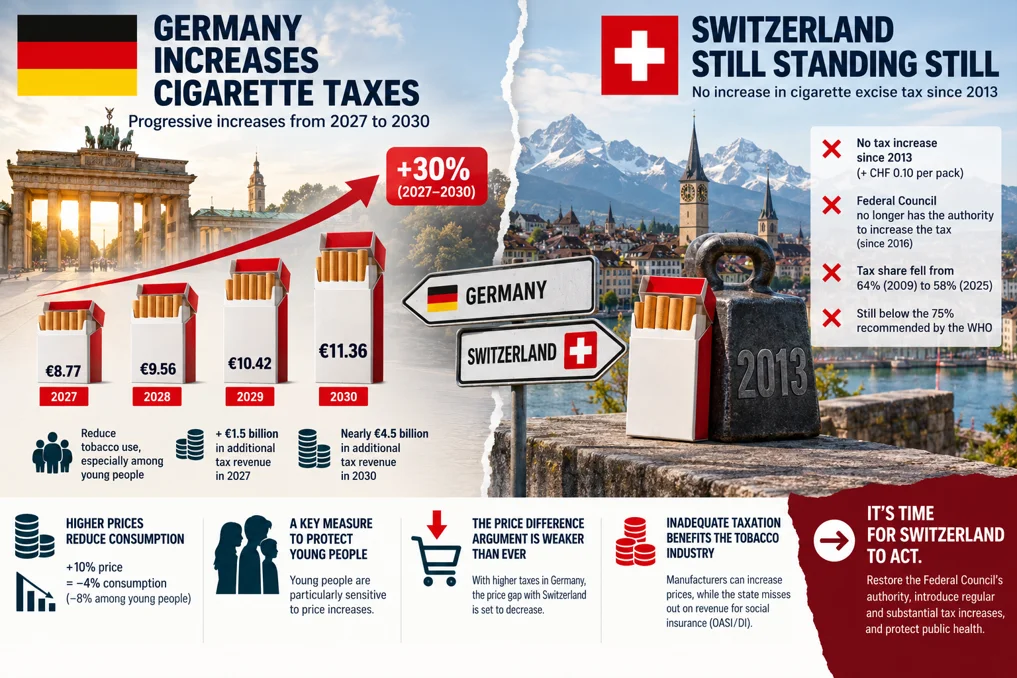
According to projections included in the government's original proposal, the average price of a pack of 20 cigarettes was expected to reach €8.77 in 2027, €9.56 in 2028, €10.42 in 2029, and €11.36 in 2030. This represents an increase of approximately 30% between 2027 and 2030. These estimates are based on the original legislative proposal and do not necessarily reflect all the effects of the amendments adopted during the parliamentary process.
The reform also covers fine-cut tobacco, heated tobacco products, waterpipe tobacco, and other tobacco substitutes. Additional tax revenues are estimated at approximately €1.5 billion as early as 2027 and nearly €4.5 billion by 2030.
The German government explicitly justifies this reform not only on fiscal grounds but also on public health objectives, particularly reducing tobacco consumption among young people and adults.
This decision sends an important political signal: even in a challenging economic environment, it is possible to substantially strengthen tobacco taxation and establish a multi-year schedule of tax increases.
Switzerland: thirteen years of tax policy paralysis
The situation in Switzerland stands in sharp contrast to developments in neighbouring Germany.
The last increase in Switzerland's cigarette excise tax took place in 2013, when it was raised by just CHF 0.10 per pack. No further increase has been introduced since then.
In December 2016, the Swiss Parliament declined to renew the Federal Council's authority to increase cigarette excise taxes, following the government's own recommendation. Since then, the federal authorities have lacked the power to raise this tax without a legislative amendment.
Cigarette prices have admittedly increased during this period. However, these increases were primarily implemented by manufacturers rather than by the Confederation. Tobacco companies were therefore able to increase their revenues per pack, while the government failed to generate additional tax revenue for the Old Age and Survivors' Insurance (OASI) system or strengthen the preventive impact of higher prices.
This development has even led to a decline in the relative share of taxation in cigarette retail prices.
According to the Swiss Federal Commission for Addiction and Prevention of Non-Communicable Diseases (EKSN/CFANT), the total tax share in the price of the most popular cigarette brands fell from 64% in 2009 to just 58% in 2025.
Switzerland therefore remains well below the 75% tax share of the retail price recommended by the World Health Organization (WHO).
The Federal Council acknowledges the effectiveness of tobacco taxation but continues to invoke cross-border shopping risks
This situation is particularly paradoxical given that the Swiss federal authorities themselves recognise the effectiveness of higher prices in reducing tobacco consumption.
The Federal Office of Public Health (FOPH) notes that a 10% increase in cigarette prices leads, on average, to a 4% reduction in consumption. Among young people, this effect can reach 8%.
Nevertheless, in its report of 19 December 2025 on the tobacco and tobacco-substitute market and their taxation, the Federal Council continues to place considerable emphasis on the risks associated with price differences between Switzerland and its neighbouring countries.
It points out that cigarettes are sometimes substantially cheaper in neighbouring countries, potentially encouraging cross-border shopping, smuggling, and illicit trade. According to the Federal Council, further increases in tobacco taxation could exacerbate these phenomena.
The report estimates that raising the overall tax burden to 75% of the retail price would increase the price of a cigarette pack to approximately CHF 15.30. It also refers to the experiences of countries such as France and the Netherlands, where a significant proportion of cigarettes consumed are not taxed on the domestic market.
The Federal Council thus continues to present international price differences as a major obstacle to a more ambitious tobacco taxation policy.
But this argument raises a fundamental question: should Switzerland really abandon a proven tobacco control measure simply because cigarettes are cheaper in some neighbouring countries?
Germany's tax increase further undermines the price-difference argument
For years, cigarette price differences between Switzerland and neighbouring countries, particularly Germany, have been used as an argument against increasing cigarette excise taxes.
Germany's latest decision changes precisely the terms of this debate.
By progressively increasing tobacco taxes through 2030, Germany will, all else being equal, narrow the cigarette price gap with Switzerland. One of the principal economic arguments used to oppose higher Swiss tobacco taxes is therefore becoming increasingly difficult to defend.
If cheaper cigarettes in Germany have so far been used as an argument against higher taxes in Switzerland, rising German cigarette prices should now, logically, become an argument in favour of increasing Swiss tobacco taxes.
It would be contradictory to continue invoking a price difference that is expected to narrow over the coming years.
It is also important to recall that the relationship between high tobacco taxes and illicit trade is far less straightforward than certain narratives suggest. In its 2025 recommendations, the Swiss Federal Commission for Addiction and Prevention of Non-Communicable Diseases emphasises that scientific studies do not identify tax increases as the main cause of illicit cigarette trade.
Other factors, including governance, the effectiveness of enforcement, illicit distribution networks, and corruption, play a decisive role.
The possibility of cross-border shopping must, of course, be taken into consideration. However, it cannot justify permanent tax policy paralysis, nor should public health objectives be subordinated to the pricing policies of neighbouring countries.
Inadequate taxation benefits the tobacco industry
The absence of cigarette excise tax increases since 2013 also has significant economic consequences: it leaves manufacturers considerable room to increase their own retail prices.
When the tobacco industry raises the price of a cigarette pack without a corresponding tax increase, a substantial proportion of the additional revenue goes to manufacturers and distributors rather than public finances.
The Swiss Federal Commission for Addiction and Prevention of Non-Communicable Diseases explicitly highlights this problem in its 2025 recommendations. It argues that maintaining inadequate taxation provides significant economic advantages to the tobacco industry and results in potential tax revenue losses for the Confederation.
The contrast is striking: while manufacturers have continued to increase their prices, Swiss cigarette excise taxes have remained unchanged.
Yet tobacco tax revenues make an important contribution to financing Switzerland's Old Age and Survivors' Insurance (OASI) and Disability Insurance (DI) systems. According to the FOPH, these revenues amounted to approximately CHF 1.9 billion in 2024.
Substantial and regular tobacco tax increases could therefore pursue two objectives simultaneously: reducing tobacco consumption and strengthening revenues for the social insurance system.
A particularly important measure to protect young people
The effectiveness of tobacco tax increases is extensively documented in scientific research and explicitly recognised by the WHO.
Young people and individuals with lower incomes are particularly sensitive to price changes. Higher taxation therefore helps prevent smoking initiation, reduce tobacco consumption, and encourage quit attempts.
In a high-income country such as Switzerland, cigarette prices must also be assessed in terms of their actual affordability, rather than simply their nominal price.
A pack of cigarettes may appear relatively expensive by international standards while remaining highly affordable when incomes are also high.
An effective taxation policy must therefore include sufficiently substantial and regular increases to progressively reduce cigarette affordability.
Symbolic adjustments of just a few cents are not enough.
Switzerland must finally overcome its tax policy paralysis
For AT Switzerland, Germany's decision should serve as a clear political signal.
Switzerland cannot continue to invoke cigarette price differences with neighbouring countries to justify its failure to increase excise taxes while those very countries are strengthening their tobacco taxation policies.
The Swiss Parliament must urgently restore the Federal Council's authority to increase tobacco excise taxes and adopt a schedule of regular and substantial tax increases.
Such a reform should pursue three priority objectives:
- Progressively increase the total tax share of cigarette retail prices to at least 75%, in line with WHO recommendations.
- Introduce regular and sufficiently substantial tax increases to reduce cigarette affordability, particularly among young people.
- Reform taxation of other tobacco and nicotine products in parallel, taking account of market developments and preventing substitution driven solely by differences in tax treatment.
Switzerland has compelling public health, economic, and fiscal reasons to act.
Thirteen years without an increase in cigarette excise taxes means thirteen years of missed opportunities for tobacco control. While Germany has chosen to act, Switzerland must finally stop using international price differences as an excuse for continued tax policy inaction.
It is time to put public health ahead of the economic interests of the tobacco industry.
1. German Bundestag (15 October 2026). Bundestag beschliesst Erhöhung der Tabaksteuer. Information on the legislative proposal, parliamentary amendments, and vote.
https://www.bundestag.de/dokumente/textarchiv/2026/kw42-de-tabaksteuer-1224154
2. German Bundestag (14 October 2026). Tabaksteuer wird erhöht. Information on amendments to the proposed legislation and expected additional tax revenues.
https://www.bundestag.de/presse/hib/kurzmeldungen-1224762
3. Deutschlandfunk (16 October 2026). Bundesrat winkt Erhöhung der Tabaksteuer durch.
https://www.deutschlandfunk.de/bundesrat-winkt-erhoehung-der-tabaksteuer-durch-102.html
4. Swiss Federal Council (19 December 2025). Report on the tobacco and tobacco-substitute products market. Report in response to parliamentary postulates 23.3588 and 24.4229.
https://www.bazg.admin.ch/fr/newnsb/ZeaHNEEJkTmXSDrbNChOG
5. Swiss Federal Office of Public Health (FOPH). Tobacco taxation: Higher prices reduce consumption. Information on tobacco taxation, its preventive effectiveness, and tax revenues.
https://www.bag.admin.ch/fr/imposition-du-tabac-les-prix-eleves-font-baisser-la-consommation
6. Swiss Federal Commission for Addiction and Prevention of Non-Communicable Diseases (2025). Reforming tobacco taxation in the interest of public health: Recommendations of the Commission.
https://www.bag.admin.ch/dam/fr/sd-web/ZbeTH5tEeqVW/reforme_taxation-tabac_Position_CFANT.pdf
7. World Health Organization (2025). WHO Report on the Global Tobacco Epidemic 2025.
https://www.who.int/teams/health-promotion/tobacco-control/global-tobacco-report-2025