- 25.11.2026
- News
Households with children: 40.8% of e-cigarette users vape indoors
In households with children, 40.8% of e-cigarette users report vaping inside their homes, compared with just 4.7% of conventional cigarette smokers. This striking contrast, revealed by the 2025 Health and Lifestyle Survey, raises important questions about how the risks of newer nicotine products are perceived and how people can be protected from involuntary exposure.
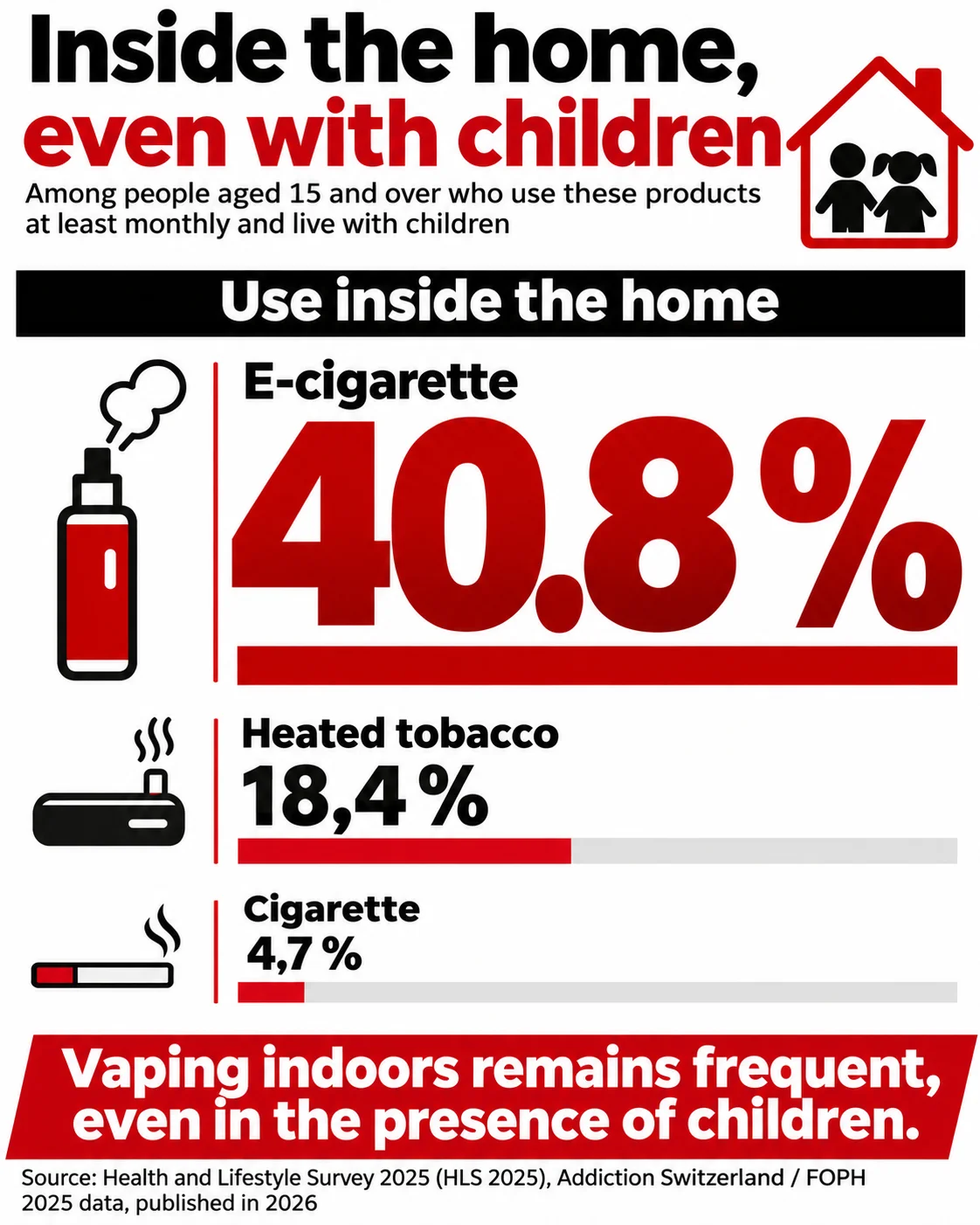
The findings of the 2025 Health and Lifestyle Survey, published in 2026, reveal substantial differences in the use of tobacco and nicotine products at home. While smoking conventional cigarettes indoors appears relatively uncommon in households with children, vaping is considerably more widespread.
These figures refer to people aged 15 and over who use the respective product at least once a month. They do not directly measure children's exposure or establish users' motivations. Nevertheless, they raise an important question: are e-cigarettes perceived as sufficiently harmless to be used in places where people would no longer smoke conventional cigarettes?
Contrary to a widespread misconception, e-cigarettes do not simply produce water vapour. They generate aerosols that may contain nicotine, fine particles and other substances. Although the long-term health effects of secondhand exposure remain insufficiently documented, the presence of these aerosols in indoor air deserves particular attention.
How can residents be better protected from secondhand smoke and aerosols from newer nicotine products? In a new in-depth article, AT Switzerland examines an Australian study published in Tobacco Control, discusses gaps in legal protection in Swiss residential buildings and explores several approaches to prevention.
Read more: Secondhand smoke in homes: a public health issue, not merely a neighbour dispute
Data source: 2025 Health and Lifestyle Survey, published in 2026, Swiss Federal Office of Public Health / Addiction Switzerland.