- 25.11.2026
- Blog
Secondhand smoke in homes: a public health issue, not merely a neighbour dispute
Smoke drifting between homes is often treated as a simple dispute between neighbours. An Australian study published in Tobacco Control suggests that this framing may hinder the adoption of protective measures. In Switzerland, where protection against secondhand smoke in private homes remains inadequate, residential exposure is a significant public health concern, now compounded by exposure to aerosols from electronic cigarettes.
Researchers at the University of Queensland analysed 220 Australian news articles published between 2015 and 2024 that addressed smoking and smoke drifting into residential properties. Nearly three-quarters of the articles (72%) discussed the issue in multi-unit housing. A majority (61%) included views supporting changes to existing regulations.
Beyond these figures, the researchers examined how media coverage shapes public debate. Their qualitative analysis of 89 articles identified three main frames: competing individual rights, the practical difficulties experienced by those exposed to smoke, and the responsibility of public authorities to protect health.
A neighbour dispute or a public health issue?
According to the researchers, portraying smoke drifting between homes as a clash between individual freedoms obscures a fundamental distinction: smoking in one's own home is a personal choice, whereas being exposed to someone else's smoke means involuntarily inhaling harmful substances.
Presenting these two claims as equally legitimate rights risks diverting attention from the health consequences and discouraging policy action.
The personal accounts examined in the study also illustrate the difficulties faced by affected residents: being unable to ventilate their homes, ongoing disputes with neighbours, costly administrative and legal procedures, and feelings of helplessness. Some ultimately leave their homes because they cannot find a solution.
The researchers highlight how people exposed to smoke often bear most of the consequences, while public authorities and property management bodies have powers to intervene but may be reluctant to exercise them.
These difficulties are not unique to Australia. In Switzerland, too, people experiencing smoke intrusion in their homes often have to undertake lengthy procedures themselves to find a solution. Such experiences are documented by the national platform passivesmoke.ch, which focuses on protection from secondhand smoke.
Putting health protection at the centre of the debate
The authors suggest that better communication about the health consequences of secondhand smoke and the need to protect vulnerable groups, particularly children, could help promote effective protective measures.
These findings are also relevant to Switzerland. Despite progress in protecting people from secondhand smoke in public places and workplaces, smoke drifting between residential properties remains a difficult problem to address.
The Swiss Association for Tobacco Prevention (AT Switzerland) considers it essential to recognise this exposure as a public health issue rather than simply a disagreement between neighbours.
In Switzerland, legal protection remains incomplete
The entry into force of the Federal Act on Protection against Passive Smoking on 1 May 2010 marked an important step forward for tobacco prevention in Switzerland. It helped limit exposure to tobacco smoke in enclosed spaces accessible to the public and in workplaces used by more than one person.
However, this protection has a major limitation: it does not generally extend to private homes. People exposed to smoke drifting from neighbouring apartments, balconies or building ventilation systems do not enjoy the same level of protection as they would in a restaurant or office.
Since October 2024, the smoking restrictions established by federal legislation have also applied to electronic cigarettes and heated tobacco products. This extension has not, however, addressed the gaps in protection within private homes.
In residential settings, affected individuals must primarily rely on tenancy law and the legal provisions governing neighbour relations. Proceedings can be lengthy, complex and difficult to pursue successfully. This is precisely the imbalance identified by the Australian researchers: when secondhand smoke exposure is treated as a matter of neighbourly coexistence, responsibility for finding a solution falls largely on those who suffer its consequences.
Smoke intrusion can be difficult to control
Smoke intrusion is not limited to tobacco smoke entering from a neighbouring balcony. It can also occur through ventilation ducts, stairwells, gaps around doors or defects in a building's airtightness. Pressure differences and air movements can facilitate these transfers, sometimes even when windows are closed.
Another concern is thirdhand smoke: residues from tobacco smoke accumulate on surfaces, textiles and household dust, where they can persist and subsequently be released back into the indoor environment.
Protecting residents from secondhand smoke therefore also requires technical expertise and the involvement of property management and building professionals. Improvements to ventilation systems or building airtightness may reduce smoke intrusion, but they cannot replace preventing emissions at their source.
The Australian study thus highlights the importance of an approach that goes beyond individual neighbour disputes by combining health protection, information, support for affected residents and consideration of collective responsibilities.
Electronic cigarettes: a new form of secondhand exposure
For many years, secondhand smoke was associated almost exclusively with conventional cigarettes. The growing use of electronic cigarettes and heated tobacco products is now changing consumption patterns and the forms of exposure occurring indoors.
Contrary to a still widespread misconception, electronic cigarettes do not simply produce water vapour. They generate an aerosol that may contain nicotine, fine and ultrafine particles, volatile organic compounds, irritants and certain metals, depending on the product and how it is used.
Some of these substances are released into the surrounding air when users exhale. People nearby may therefore be exposed even if they do not use these products themselves.
Scientific knowledge about the long-term health consequences of this exposure remains less extensive than the evidence available for conventional tobacco smoke. It would therefore be inaccurate to suggest that the risks are identical or of the same magnitude.
Nevertheless, existing research indicates that secondhand exposure to e-cigarette aerosols is not harmless.
A systematic review published in Respiratory Medicine in 2026, examining the health effects of passive exposure to alternative tobacco products, reported associations between exposure to e-cigarette aerosols and respiratory symptoms, irritation and certain biological markers. The authors also highlighted methodological limitations in the available studies and the need for further research.
These findings support taking involuntary exposure to aerosols seriously, particularly in enclosed spaces and where children or people with respiratory conditions are present.
In Switzerland, electronic cigarettes are used indoors far more frequently
The findings of the 2025 Health and Lifestyle Survey, published in 2026, provide particularly valuable insights into the use of tobacco and nicotine products in Swiss homes.
Among people aged 15 and over who use the respective product at least once a month, the proportion reporting indoor use at home varies considerably:
- 50.5% of e-cigarette users report vaping inside their homes.
- 28.3% of heated tobacco product users report using these products indoors at home.
- 12.7% of conventional cigarette smokers report smoking inside their homes.
The difference is particularly striking in households with children: 40.8% of e-cigarette users living in such households report vaping indoors, compared with 4.7% of conventional cigarette smokers.
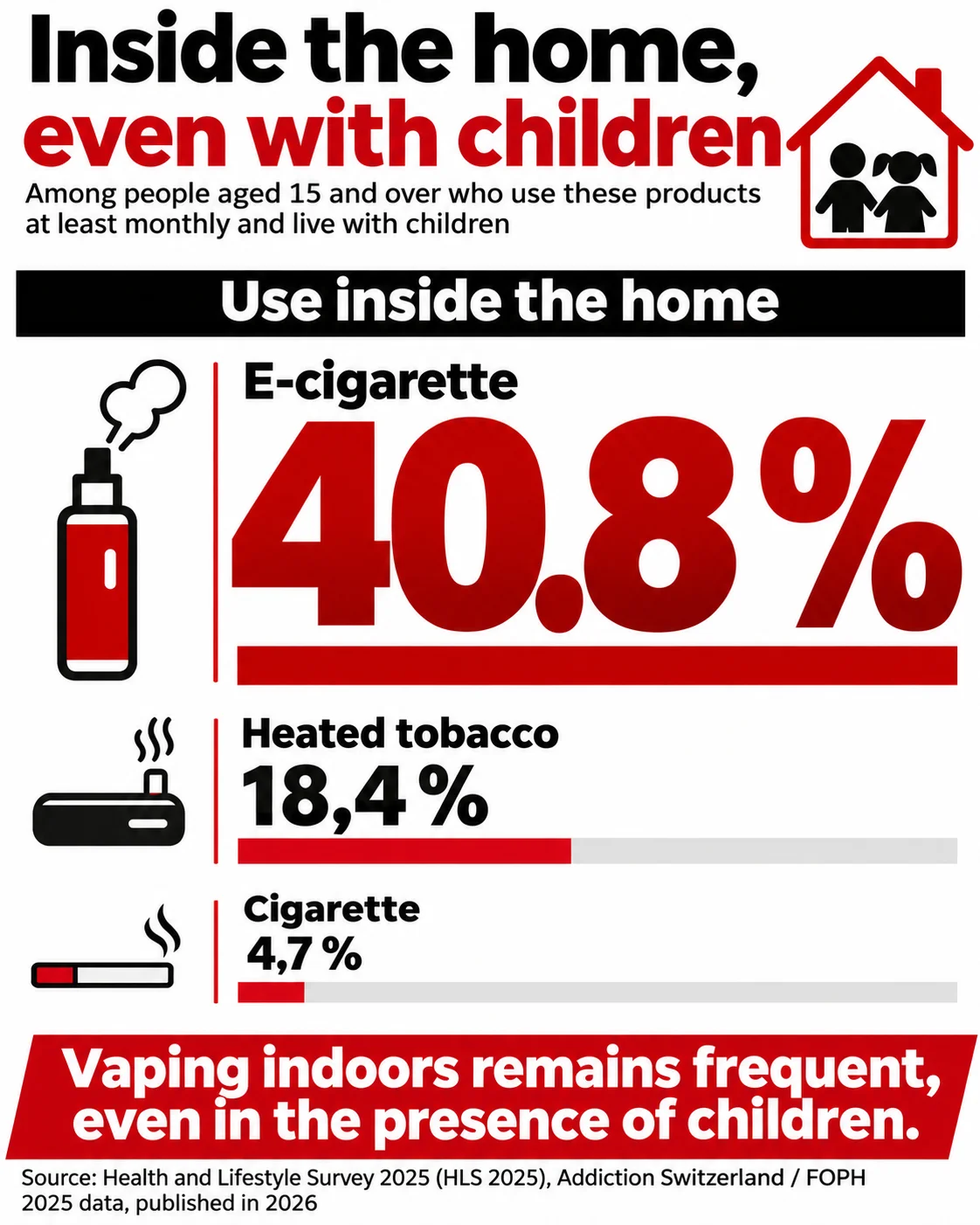
These figures do not directly measure other household members' exposure. However, they reveal substantial differences in indoor consumption patterns across products.
This trend raises an important question: are electronic cigarettes and heated tobacco products perceived as sufficiently harmless to be used in situations where people would refrain from smoking conventional cigarettes?
The data alone cannot establish users' motivations. They nevertheless highlight the need to examine how risks are perceived.
The absence of the characteristic smoke or smell of a conventional cigarette does not mean that a product's emissions are harmless to others.
Prevention messages must therefore clearly distinguish between the absence of combustion and the absence of health risks.
Addressing gaps in public awareness and scientific knowledge
Efforts to prevent secondhand smoke exposure have benefited from decades of scientific research and public information campaigns. Awareness of the health risks associated with inhaling other people's tobacco smoke is now considerably greater.
Communicating the risks associated with electronic cigarettes remains more challenging.
Public debate frequently focuses on comparing the risks of vaping and smoking for people who use these products. The exposure of bystanders receives less attention.
Yet these are two distinct issues. Even if a product exposes its user to lower levels of certain toxic substances than a conventional cigarette, this does not mean its use has no consequences for other people nearby.
Effective public information should therefore explain what e-cigarette aerosols may contain, how they spread in enclosed spaces and what scientific evidence exists regarding their potential health effects.
It should also acknowledge existing uncertainties. Devices, liquids, nicotine concentrations and patterns of use vary considerably. The health consequences of repeated, long-term secondhand exposure remain insufficiently documented.
These uncertainties justify neither downplaying secondhand vaping exposure nor making alarmist claims that go beyond the available evidence.
Instead, prevention efforts should be grounded in scientific evidence, regularly updated and attentive to vulnerable populations.
Moving beyond individual disputes: what measures should Switzerland consider?
The significance of the Australian study extends beyond its analysis of media coverage. It encourages a broader discussion of how societies define responsibility for protecting people from involuntary exposure to harmful substances.
Several areas for action could be considered in Switzerland.
- Clarify legal protection in residential settings. The existing legal framework could be reviewed to determine when people exposed to smoke intrusion should benefit from more explicit safeguards. Such a review should consider residents' rights, the proportionality of potential measures and their practical implementation.
- Improve information about emissions from newer products. Prevention campaigns should give greater attention to secondhand exposure to e-cigarette aerosols and emissions from heated tobacco products. Particular attention should be paid to households with children, facilities used by vulnerable people and shared living environments.
- Develop accessible procedures for affected residents. The responsibilities of landlords, property managers, mediation services and tenants' associations should be better defined so that resolving smoke-related problems does not depend exclusively on the personal and financial resources of those affected.
- Strengthen scientific research and Swiss data. Research should better document the prevalence of smoke intrusion between homes, exposure to e-cigarette aerosols, the health consequences of chronic exposure and the effectiveness of different protective measures.
- Give greater consideration to technical and architectural factors. Air movement within buildings deserves more attention in prevention strategies. Property professionals, ventilation specialists and relevant authorities could contribute to developing practical recommendations.
- Strengthen advice and support services. Protective measures must also consider people living with nicotine dependence and those facing social disadvantage. Access to smoking cessation services and appropriate support can help reduce emissions without creating additional difficulties for vulnerable populations.
Health protection should not stop at the front door
The Australian study reveals a fundamental paradox: exposure recognised as a public health problem can become, as soon as it occurs in a residential setting, an issue framed primarily as a private dispute between individuals.
A similar tension exists in Switzerland. Since 2010, protection from secondhand smoke has improved in public places and workplaces. Yet people exposed to tobacco smoke in their own homes must still often find solutions themselves, sometimes through lengthy and difficult procedures.
The emergence of newer nicotine products makes this issue even more pressing. Aerosols from electronic cigarettes and emissions from heated tobacco products call for further research, better public information and a reassessment of existing prevention measures.
This is not about disregarding individual freedom or the practical difficulties of regulating private spaces. Rather, it is about recognising that exercising individual freedom can have health consequences for others, and that these consequences must be taken into account.
The question raised by the Australian researchers therefore deserves consideration in Switzerland as well: why is protection against involuntary exposure to harmful substances regarded as a collective responsibility in public spaces, while people exposed in their own homes are largely left to negotiate solutions individually?
Improving protection from secondhand smoke means moving beyond this opposition and fully recognising the home as an essential setting for health protection and prevention.
Main sources
- Lai G., Gartner C. E., Morphett K. (2026). Your rights versus my rights: Australian media representation of smoking and secondhand smoke in homes. Tobacco Control, 3 September 2026. DOI.
- Swiss Federal Office of Public Health / Addiction Switzerland (2026). Tobacco and nicotine products: results of the 2025 Health and Lifestyle Survey and recent developments. Report and data.
- Health impacts of passive exposure to alternative tobacco products: a systematic review (2026). Respiratory Medicine. Scientific article.
- Swiss Federal Office of Public Health. Protection against secondhand smoke in the cantons.
- Swiss Federal Office of Public Health. Tobacco legislation.
- AT Switzerland and partners. passivesmoke.ch.