- 05.06.2026
- News
- Blog
Europe warns of new pathways to nicotine
Nicotine is changing its face. While conventional cigarette smoking continues to decline overall across Europe, new products are rapidly reshaping the landscape of addiction: e-cigarettes, nicotine pouches, heated tobacco products, digital marketing and influence strategies targeting younger generations.
From 20 to 22 May, the 10th edition of the European Conference on Tobacco or Health (ECToH) brought together researchers, policymakers, public health organisations and prevention experts from across Europe under a revealing theme: “Nicotine-Free Spaces for Healthier Cities”.
Behind this slogan, however, one observation repeatedly emerged throughout the conference: smoking rates may be slowly declining, but nicotine is finding new pathways.

“This is not harm reduction, this is harm creation”
The tone was set from the very beginning of the conference.
In a recorded video message, World Health Organization (WHO) Director-General Tedros Adhanom Ghebreyesus denounced the new forms of addiction associated with emerging nicotine products with a statement that resonated strongly among participants:
“This is not harm reduction, this is harm creation.”
Over the course of three days, speakers repeatedly returned to a common concern: the tobacco and nicotine industry is not disappearing. It is transforming itself.
Dr Silvano Gallus, Chair of the ECToH 2026 Scientific Committee and researcher at the Mario Negri Institute in Milan, highlighted that Europe is entering a particularly complex phase in tobacco and nicotine control. While cigarette smoking is gradually declining in several European countries, the rapid growth of new nicotine products is causing increasing concern among public health experts.
Several scientific sessions focused on e-cigarettes, heated tobacco products and nicotine pouches, whose use is rising rapidly among young people in a number of European countries. Researchers also stressed that scientific knowledge remains limited regarding the long-term effects of some of these products, despite their growing popularity. At the same time, several studies presented at the conference identified toxic and carcinogenic substances in emerging nicotine products, reinforcing concerns about a future wave of health problems linked to these new forms of consumption.
Marketing strategies that are becoming increasingly difficult to detect
Among the many topics discussed in Milan, digital marketing and social media promotion received considerable attention.
Amélie Eschenbrenner of the French National Committee Against Smoking (CNCT) presented monitoring research on the promotion of nicotine products on social media platforms.
One of her key findings was that visible advertising appears to have declined on certain platforms since 2025. However, this decline is misleading.
Marketing strategies are rapidly evolving and becoming less visible rather than disappearing: private groups, SMS and email marketing, influencers, ephemeral content, emojis, memes and visual codes borrowed from adolescent digital culture.
Furthermore, these communications frequently fail to comply with legal requirements regarding health warnings. In addition, a significant proportion of the promotional content analysed did not clearly disclose its commercial nature.
The researcher also noted that flavours remain one of the main drivers of attractiveness among young consumers and continue to be a central element of nicotine marketing strategies.
New entry points into nicotine addiction
Several studies presented during the conference highlighted the ease with which minors can access new nicotine products.
During a session dedicated to youth smoking and nicotine use, Marta Agnieszka Miller, a researcher involved in the PolNicoYouth study in Poland, presented data showing a sharp increase in the use of e-cigarettes and nicotine pouches among adolescents. Other presentations indicated that initiation into some nicotine products now occurs as early as 13 or 14 years of age.
According to several researchers attending the conference, e-cigarettes have become the most commonly used nicotine products among adolescents in a number of European countries, surpassing conventional cigarettes.
Nicotine pouches are also an increasing source of concern. During a dedicated session, Lotus Sofie Bast, Senior Researcher at the National Institute of Public Health at the University of Southern Denmark, examined the profile of these new consumers. Are nicotine pouches mainly used by existing smokers, or are they attracting an entirely new population into nicotine dependence?
According to the data presented, these products appear to be attracting predominantly new users rather than young people who already smoke conventional cigarettes.
A new cultural battle around nicotine
Beyond the products themselves, several speakers emphasised a broader trend: the gradual normalisation of nicotine products within digital and cultural environments frequented by young people.
The issue now extends beyond individual products to an entire nicotine ecosystem that has become increasingly present in social media, youth culture and certain public spaces.
In this context, several speakers argued that public health policies can no longer focus solely on regulating individual products. They must also address the wider nicotine industry and its influence on consumer behaviour, digital environments and social norms.
Price, taxation and social inequalities
Several experts also reminded participants that people with lower incomes continue to bear a disproportionate burden of tobacco use and its health consequences.
In this context, price and taxation policies were repeatedly presented as among the most effective tools for reducing consumption, particularly among young people.
Switzerland still among Europe’s poorest performers
The first day of the conference also featured the official presentation of the Tobacco Control Scale 2025, the European ranking that evaluates tobacco control policies across 37 countries.
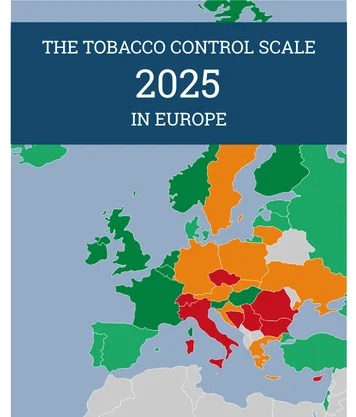
Switzerland ranked second from last.
As recently highlighted by AT Switzerland, this ranking reflects major shortcomings in Switzerland’s regulation of tobacco and nicotine advertising, protection against tobacco industry interference and regulation of emerging nicotine products.
Speaking at the conference opening, Dirk Van den Steen from the European Commission’s Directorate-General for Health and Food Safety (DG SANTE) stressed that recent progress in Europe should not overshadow the challenges ahead.
“This is not a sprint, but a marathon.”
Regulating products — and the industry behind them
Several sessions dedicated to tobacco industry interference in research, policymaking and public communication highlighted the significant repositioning strategies currently being deployed around so-called “harm reduction” products.
Beyond the scientific debate, several experts described a broader effort by the tobacco and nicotine industry to gradually present itself not as part of the problem, but as part of the solution.
At the same time, several speakers argued that this strategic use of the concept of harm reduction contributes to blurring public understanding of the risks associated with products that maintain nicotine addiction and increasingly attract a new generation of consumers.
In Milan, many participants emphasised that tobacco control is entering a new phase.
For decades, public health policies focused primarily on conventional cigarettes. Today, prevention professionals face a far more fragmented, digital and rapidly evolving environment in which nicotine spreads through new products, new cultural codes and new commercial strategies.
One question seemed to run through many discussions during the conference: how can society prevent a new generation from developing nicotine dependence when nicotine itself has become more discreet, more technological, more pervasive — and is sometimes even presented as modern or harmless?
For many experts in Milan, the challenge of the coming years will therefore not simply be regulating individual products, but also addressing the industrial and commercial strategies that now drive the spread of nicotine across digital, social and cultural spaces frequented by young people.
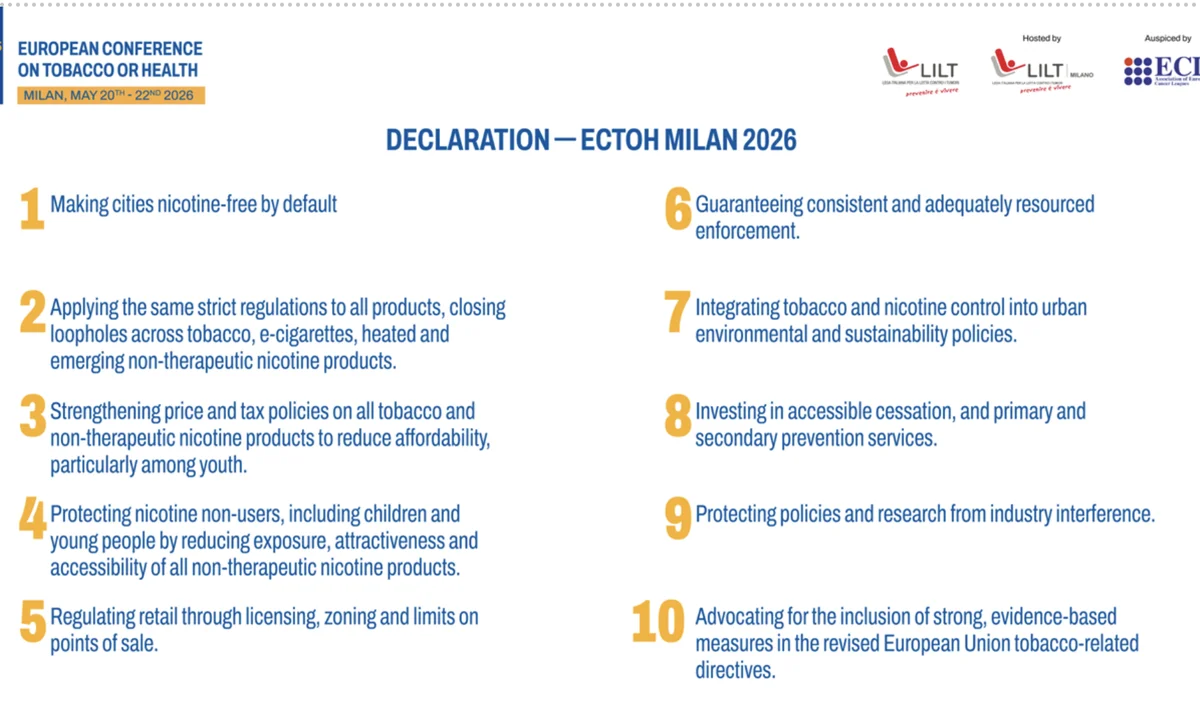
Finally, the ECToH Scientific Committee called on local, national and European authorities to implement and enforce ambitious and comprehensive measures covering all tobacco, nicotine and related products. These include strong regulatory frameworks, strengthened price and taxation policies, and effective protection of young people, the environment and public institutions from industry interference.
AT Switzerland actively involved in ECToH 2026AT Switzerland played an active role throughout the three-day European Conference on Tobacco or Health (ECToH). AT Switzerland Director Luciano Ruggia served on the conference’s Scientific Committee. He also chaired a session on Novel and Emerging Nicotine and Tobacco Products and delivered a presentation on these emerging products. AT Switzerland Communications Manager Benoît Perriard presented a poster on the national passive smoking platform passivesmoke.ch, chaired a scientific poster session and provided journalistic coverage of the conference for this article. Knowledge Management Project Manager Kris Schürch participated in the plenary panel discussion on the Tobacco Control Scale, chaired a scientific poster session and presented a poster entitled Sociodemographic Differences in Smoking Behaviours by Migration Background. |