- 05.06.2026
- News
United States: FDA Strengthens Oversight of Chemicals Found in E-Cigarettes
In a communication published on April 22, 2026, and largely overlooked by the public, the U.S. Food and Drug Administration (FDA) announced the addition of 18 new substances to its official list of Harmful and Potentially Harmful Constituents (HPHCs) found in tobacco and nicotine products. This decision notably affects several components widely used in e-cigarettes and other novel nicotine products. The FDA has also opened a public consultation regarding three additional flavoring substances.
E-cigarette Liquids
Among the newly added constituents are propylene glycol (PG) and vegetable glycerin (VG), which form the basis of most e-liquids used in e-cigarettes. In the vast majority of e-liquids, propylene glycol (PG) and vegetable glycerin (VG) together account for between 90 and 99 percent of the liquid, with the remainder consisting of nicotine, flavorings, and sometimes other additives. The updated list also includes several compounds associated with flavorings or that may be generated during the heating of e-liquids.
This development is particularly significant. For many years, the vaping industry has frequently presented PG and VG as “food-grade” or “commonly used” ingredients, sometimes implying that they are virtually harmless. The FDA’s decision serves as a reminder that a substance used in food cannot automatically be considered risk-free when repeatedly inhaled as an aerosol.
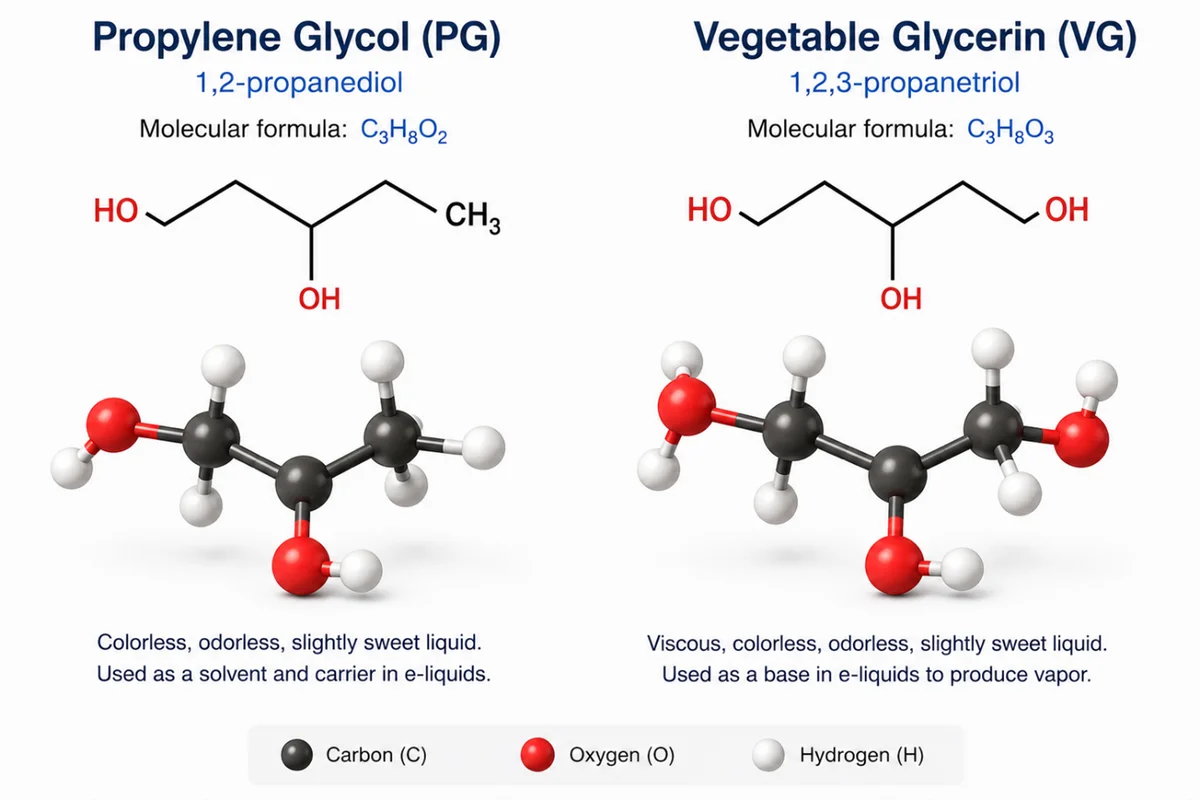
The FDA emphasizes that inclusion on the HPHC list does not constitute a ban on these substances. Rather, the list is intended to guide the scientific evaluation of products submitted for market authorization. Manufacturers may therefore be required to provide additional data on the presence of these compounds in product emissions and on their potential health effects.
Heated Tobacco Products Are Also Affected
This decision also concerns heated tobacco products such as IQOS by Philip Morris International (PMI) and glo by British American Tobacco (BAT). Propylene glycol (PG) is an essential ingredient in many heated tobacco sticks. It is added to reconstituted tobacco to maintain moisture, facilitate aerosol generation, enhance nicotine delivery, and stabilize certain flavorings. Vegetable glycerin (VG) may also be present, although generally in lower quantities than in e-cigarettes. For example, IQOS HEETS and TEREA sticks contain PG alongside other ingredients such as reconstituted tobacco, water, glycerin, cellulose, and flavorings.
For several years, Philip Morris has promoted IQOS on the basis that it heats tobacco rather than burning it, suggesting a substantial reduction in harmful substances associated with combustion. However, the absence of combustion does not mean the absence of exposure to toxic substances. When heated, propylene glycol (PG) and vegetable glycerin (VG)—used in both heated tobacco products and e-cigarettes to generate the inhaled aerosol—can degrade and form compounds such as formaldehyde, acetaldehyde, acrolein, and glycidol. Several of these substances are already included on the FDA’s HPHC list, while others have recently been added. This decision highlights that heated tobacco products and e-cigarettes are not limited to delivering nicotine: they also generate complex aerosols containing solvents, thermal degradation products, and other substances that may pose health risks.
The Need for Better Monitoring and Regulation of These Chemical Substances
For Switzerland, this decision confirms the need to pay closer attention to the complex and constantly evolving chemical compositions of novel tobacco and nicotine products, as well as to the full chemical composition of the aerosols inhaled by consumers. As e-cigarettes, heated tobacco products, and nicotine pouches continue to gain market share in Switzerland, this development underscores the importance of a regulatory framework based on independent, transparent, and regularly updated toxicological assessments.
Although the Swiss Tobacco Products Act (TobPA) contains provisions relating to ingredients and emissions, it does not currently provide an approach comparable to the FDA’s HPHC list that would allow for the systematic identification and monitoring of harmful or potentially harmful substances in novel nicotine products. This represents one of the many weaknesses of the new Swiss legislation that entered into force in October 2024.
This announcement also comes at a time when many questions remain regarding the long-term effects of chronic exposure to solvents, flavorings, and thermal degradation products found in novel nicotine products. It demonstrates that even in the United States, often portrayed as relatively open to vaping products, authorities are progressively strengthening their oversight of the chemical constituents present in these products.
Source : FDA, Center for Tobacco Products, avril 2026. https://www.fda.gov/tobacco-products/ctp-newsroom/fda-adds-18-constituents-list-harmful-and-potentially-harmful-constituents-seeks-comment-three?utm_campaign=ctp-hphc&utm_content=statement&utm_medium=email&utm_source=govdelivery&utm_term=stratout