- 10.06.2026
- News
- Blog
When Youth Lead, Policy Follows: Lessons from Africa for Switzerland
Africa is at a critical turning point in the global tobacco epidemic. With the world's youngest population, rapidly expanding digital markets, and a tobacco industry increasingly focusing its efforts on countries with weaker regulations, the continent is at risk of becoming the next major growth market for tobacco and nicotine manufacturers. What can be done? This article brings together two complementary perspectives that illustrate what meaningful, youth-led tobacco control can look like in practice.
The first section presents the practical work of Y-ACT (Youth in Action), from capacity building and advocacy to national mobilisation and regional and global policy engagement. It shows how youth leadership can translate into tangible, real-world impact. Today, young people represent one of Africa's greatest yet still underutilised forces for prevention and change.
The second section features an in-depth interview with Winnie Olwal, one of the leading voices for youth-led health promotion in Africa. She explains why youth leadership is essential if Africa is to avoid repeating the public health mistakes made elsewhere.
Together, these two perspectives convey a simple yet urgent message: youth advocacy is not merely symbolic—it is a strategic necessity. In Africa, Switzerland and beyond, supporting young leaders is now essential to developing credible, effective and forward-looking tobacco control policies.
Limited influence on policymaking
Until now, young people have largely been viewed as passive beneficiaries of health services rather than as genuine political actors. Yet the experience of Y-ACT, founded in 2017, demonstrates across Africa that when young people are equipped with the right tools, knowledge and platforms, they are able to challenge industry narratives, influence policy agendas and hold decision-makers accountable—in ways that traditional advocacy cannot always achieve.
This reality is not limited to low- and middle-income countries. It should also inspire high-income countries such as Switzerland, where youth participation in tobacco control policymaking remains, in practice, limited, fragmented or largely symbolic.
The youth-led advocacy model emerging across Africa demonstrates that meaningful participation is not primarily a question of resources, but of political will, trust and a genuine willingness to share power. Countries such as Switzerland have much to learn from these approaches, particularly at a time when new nicotine products, including e-cigarettes, are targeting young people across every region of the world.
Y-ACT leading the way
Active in 21 African countries, Y-ACT provides young advocates and youth-led organisations with training, mentorship and capacity-building support. Since 2020, more than 1,000 young advocates from across the continent—including Zambia, South Africa and Sierra Leone, the programme's pioneering countries—have completed its online training programme, gaining the skills needed to drive change in their respective countries.
Y-ACT was established within the African Medical and Research Foundation (Amref Health Africa), the largest African non-governmental health organisation. Its mission is to harness the energy, creativity and commitment of young people across the continent. The organisation offers tailored training, mentorship, coalition-building support and capacity-strengthening opportunities to young advocates and the organisations they lead.
Its guiding principle is straightforward: Africa's young people have a unique opportunity to influence public policy, challenge harmful industry practices and help build a healthier future for themselves and their communities. Its philosophy can be summed up in a simple phrase: led by young people, driven by young people, and designed for young people.
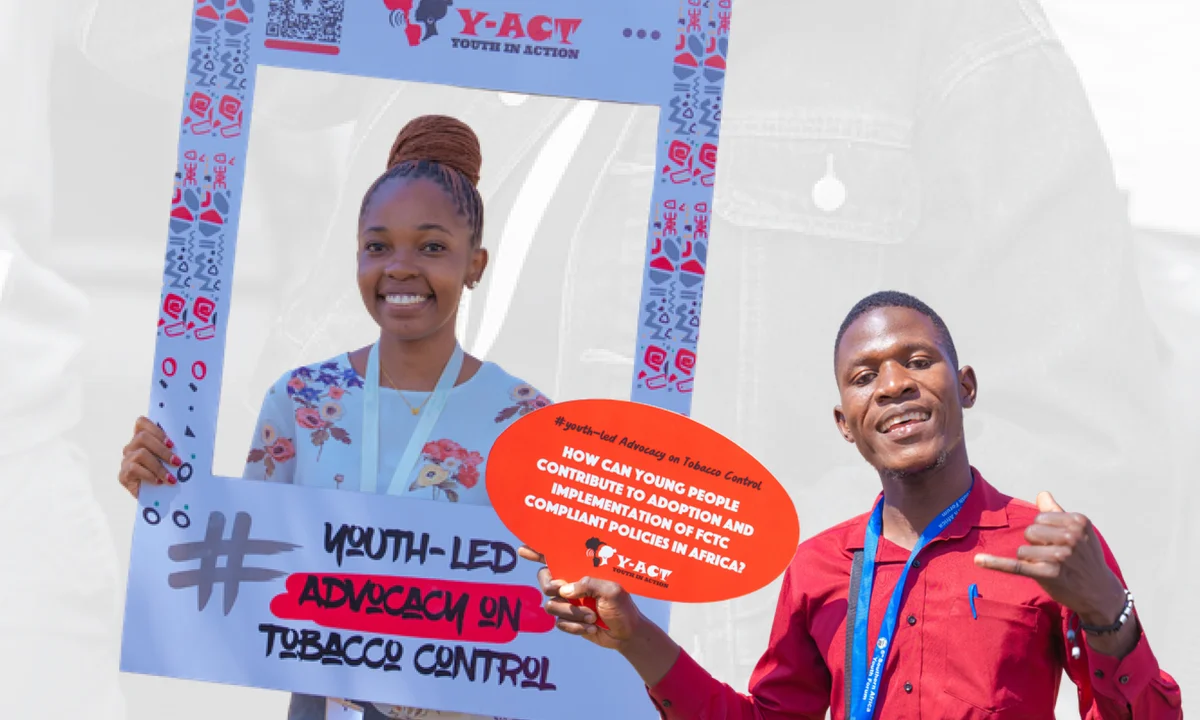
Youth-led advocacy for a tobacco-free Africa
At a time when many African countries are experiencing rising tobacco use among young people, their role in shaping public health policy has never been more important. Through Y-ACT, young Africans are no longer passive observers but active agents of change. Recent initiatives, including the launch of Sierra Leone's first Tobacco Control School Clubs and Y-ACT's participation at the World Conference on Tobacco Control 2025, illustrate how this youth leadership is already translating into concrete action.
Fully aware of shifting global markets, the tobacco industry is increasingly targeting young people through aggressive marketing, social media and influencer campaigns to recruit a new generation of consumers.
If prevention efforts fail today, Africa risks becoming the next global epicentre of tobacco-related disease. Even more concerning, many young people could grow up without having a meaningful voice in the policy decisions that will shape their future. This is why youth-led engagement is not simply important—it is essential.
From training to action: advocacy and capacity building
In 2020, Y-ACT launched the first advocacy training programme specifically designed for young Africans. Available through Amref's online learning platform as well as a mobile application, the programme is accessible even to participants living in remote areas. More than 1,000 young advocates from across Africa have enrolled in the course. It covers topics including strategic advocacy, as well as monitoring and evaluation, equipping participants with the skills needed to drive change in their respective countries.
Strengthening tobacco control advocacy
The tobacco control initiative was first launched in Zambia, South Africa and Sierra Leone. Youth-led organisations and regional networks were mobilised to promote evidence-based advocacy, community engagement and effective policy action.
In Zambia, for example, more than 350 young people actively engaged a wide range of stakeholders and raised public awareness of the urgent need for comprehensive tobacco control legislation.
In South Africa, campaigns organised around World No Tobacco Day, school outreach activities, community dialogues and digital advocacy initiatives were implemented to counter the tobacco industry's strategies for targeting young people. All of these efforts pursued the same objective: to educate young people about the health risks of tobacco use, the dangers of second-hand smoke and the manipulative tactics employed by the tobacco industry.
more info: https://yactmovement.org/
Youth-Led Advocacy for a Tobacco-Free Africa
Interview with Winnie Olwal, Program Manager, Amref Health Africa
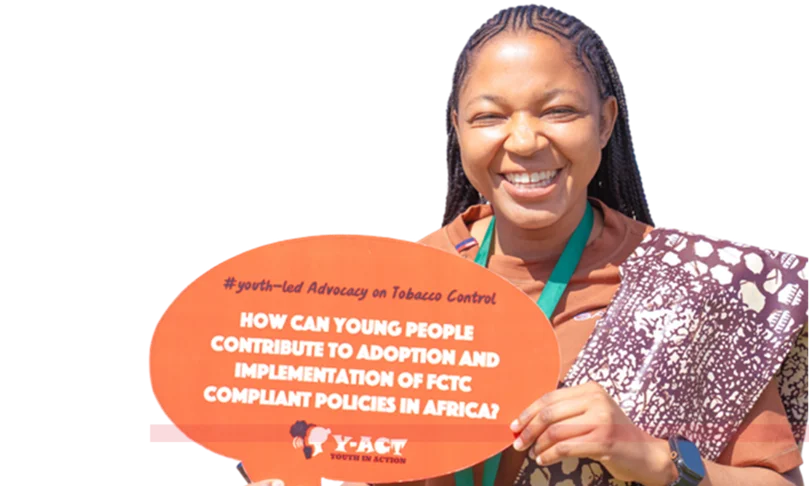
Interview with Winnie Olwal, Program Manager, Amref Health Africa
Personal journey and motivation
Winnie, what personally motivated you to become involved in tobacco control and to work with young people across Africa?
My motivation to engage in tobacco control stems from my broader commitment to public health, social justice and policy advocacy that places the most affected yet least represented communities at the centre of decision-making.
Across Africa, young people are aggressively targeted by the tobacco and nicotine industry while bearing the long-term health, social and economic consequences of tobacco use. Through my work with young people, I have seen that when they are equipped with the right knowledge, skills and platforms, they become powerful agents of change, capable of reshaping dominant narratives and influencing public policy.
Tobacco control has therefore become a natural intersection between my work to advance youth participation and my commitment to health equity: protecting young people today directly contributes to building healthier and more resilient societies tomorrow.
Why was it important to you that Y-ACT be truly youth-led rather than simply youth-focused?
A youth-led model ensures that young people are not merely present but actively involved in shaping priorities, strategies and solutions based on their own lived experiences.
This approach fosters ownership, accountability and sustainable leadership within the movement while challenging traditional power structures in public health.
By being youth-led, Y-ACT goes beyond token participation and creates a genuine pipeline of informed, credible and confident young leaders who can sustain tobacco control efforts long after individual projects or international meetings have ended.
Why youth leadership matters today
In your article, you warn that Africa risks becoming the next epicentre of tobacco-related disease. Why is this risk so real today?
This risk is real because Africa stands at the intersection of several powerful trends: a rapidly growing young population, weak or uneven implementation of tobacco control policies, and aggressive industry expansion as markets become increasingly restricted in high-income countries.
Although many African countries have strong tobacco control legislation on paper, gaps in implementation—particularly regarding taxation, advertising bans and protection from industry interference—create favourable conditions for the expansion of tobacco and emerging nicotine products.
Without sustained investment in prevention and youth-centred policy responses, the continent risks repeating the public health failures seen elsewhere, but on a far larger demographic scale.
How does the tobacco industry specifically target young people in Africa, particularly through digital marketing and influencers?
The industry increasingly exploits digital platforms popular among young people. It uses social media, lifestyle marketing, music, fashion and influencer culture to normalise and promote tobacco and nicotine use.
This marketing is often subtle and algorithm-driven, making it difficult to regulate and easy to present as personal choice or entertainment rather than advertising.
In your view, what is lost when young people are excluded from public health policymaking?
When young people are excluded from public health decision-making, policies lose relevance, credibility and long-term impact.
Young people bring lived experience, innovation and a deep understanding of emerging trends, particularly in digital spaces. Excluding them results in policies that are less responsive to real needs while weakening ownership, accountability and the long-term sustainability of public health efforts.
From training to action
Y-ACT launched the first advocacy training programme specifically designed for young Africans. What gap was this programme intended to fill?
The programme was designed to address the lack of accessible, practical and context-specific advocacy training for tobacco control across Africa.
Existing resources were often global in scope, highly technical and disconnected from the realities faced by young people, limiting their ability to participate meaningfully in policymaking.
What are the key skills the programme provides to help young advocates influence public policy and decision-makers effectively?
The programme provides technical knowledge on tobacco control policies, industry interference and tobacco taxation.
It also develops practical skills in strategic advocacy, policy analysis, evidence-based communication, coalition building and engagement with policymakers.
Why did you choose to prioritise digital accessibility through an online platform and mobile application?
Digital accessibility enables us to reach young people across diverse geographical settings, including those with limited access to in-person training.
It also supports continuous learning, peer exchange and sustained engagement beyond a single event or meeting.
Concrete action and impact
In countries such as Zambia and South Africa, hundreds of young people have mobilised. What enables this mobilisation to translate into genuine political influence?
Youth mobilisation becomes political influence when it is supported by strong technical skills, clear advocacy strategies and sustained engagement in policymaking processes.
When young advocates are organised, evidence-informed and connected to decision-making spaces such as parliamentary processes, government consultations or national delegations, their collective voice becomes credible and difficult to ignore.
Can you share a concrete example where youth engagement led to tangible change or high-level political attention?
One clear example is the Southern Africa Youth Forum, where young advocates supported by Y-ACT from across the SADC region engaged directly with regional decision-makers.
As a result of this sustained engagement, the SADC Parliamentary Forum identified tobacco control as a regional priority and endorsed the development of a regional framework law on tobacco control.
This represents a major policy achievement, demonstrating how well-structured, technically informed youth advocacy can shape regional legislative agendas and elevate tobacco control as a high-level political priority.
Beyond the numbers, how do you assess Y-ACT's real impact on the ground?
Beyond participation indicators, Y-ACT's impact is reflected in the quality of youth leadership, the strength of advocacy coalitions and young people's ability to sustain their engagement over time.
We assess this impact through improvements in their confidence, technical expertise, access to policymaking processes and the degree to which they are recognised as legitimate partners in tobacco control decision-making.
Young voices on the global stage
Why was it important for young Africans to be visible and heard at global forums such as WCTC 2025 and COP11?
Because young Africans are among those most affected by the tobacco epidemic while remaining underrepresented in global decision-making processes.
Their participation ensures that perspectives, priorities and solutions rooted in local realities help shape international policies, strengthen accountability and reinforce the message that young people are indispensable partners in the global tobacco control movement.
How did you feel when Y-ACT delivered the final Youth Declaration at COP11?
It was a powerful moment of recognition for African youth leadership.
It demonstrated that young people are not simply participants but influential contributors to the global tobacco control agenda.
Personally, it reaffirmed the value of Y-ACT's youth-led approach and reinforced the importance of empowering young people to shape public policy and hold decision-makers accountable.
Looking ahead: challenges and vision
As the tobacco industry continues to evolve, what do you see as the main emerging challenges for tobacco control in Africa?
The main challenges are the rapid growth of emerging nicotine products, increasingly aggressive digital marketing targeting young people, and more sophisticated forms of industry interference that exploit regulatory gaps.
These developments make it increasingly difficult for governments to keep pace, particularly when it comes to enforcing existing legislation and protecting vulnerable populations, especially young people.
How does Y-ACT plan to strengthen and expand youth leadership in tobacco control over the coming years?
Y-ACT plans to expand its reach by scaling up its advocacy training programme, improving digital accessibility and strengthening regional youth networks to encourage knowledge-sharing and strategic collaboration.
We will continue building technical capacity, mentoring future leaders and creating structured pathways that enable young people to participate meaningfully in national, regional and global policymaking processes.
Finally, what message would you like to share with policymakers and donors about why investing in and trusting young leaders is so important today?
Young people are among those most affected by tobacco use and are uniquely positioned to develop innovative, context-specific solutions.
Supporting and trusting young people leads to better-informed policies, more sustainable advocacy and the emergence of a new generation of leaders capable of protecting public health.
Youth leadership transforms participation into genuine ownership, making tobacco control efforts more effective, more accountable and more sustainable.