Tobacco use worldwide
- More than 1.2 billion people use tobacco worldwide.
- In 2021, smoking was associated with an estimated 6.2 million deaths worldwide.
- Switzerland has higher proportions of smokers than other high-income countries, even though these countries already have higher smoking prevalence by international comparison.
- Compared with the countries that are most advanced in tobacco control, Switzerland performs poorly, with high smoking prevalence, particularly among young people.
In the absence of fully comparable data sources, any analysis of smoking in Switzerland in international comparison needs to be interpreted critically. On the one hand, epidemiological surveys need to be specifically adapted to a country’s socio-economic, linguistic and legal context. In addition, the need for measures to remain comparable over time – from a monitoring perspective, this often means relying on surveys already established at national level – reduces the validity of such comparisons. On the other hand, international comparisons may also be limited by the fundamentally sociocultural, and even historical, nature of tobacco use, as well as by sometimes very different legal contexts. Taken together, these factors can have important implications for how the data can be interpreted. For example, major advances in tobacco control within a country may take a long time to show effects and to appear successful in international comparisons. Nevertheless, when interpreted with caution, some international attempts to standardise prevalence estimates, such as those carried out as part of the Global Burden of Disease project[1] [2], together with estimates from the Health Behaviour in School-aged Children survey[3] [4], provide information on the evolution of smoking worldwide and on Switzerland’s overall position in this area.
It should also be noted that various initiatives compare Switzerland’s international position in other areas, for example in relation to tobacco control measures (see our Tobacco Control Scale page) or the potential for industry interference in political and legislative processes (see our Global Tobacco Industry Interference Index page).
Smoking worldwide
The Global Burden of Disease collaboration (GBD[1] [2] [5]) is the most comprehensive effort to date to measure levels and epidemiological trends in smoking worldwide. It provides global estimates of smoking prevalence based on data from 3,600 representative surveys conducted in more than 200 countries. On this basis, it was estimated that, worldwide, 28.5% of men and 6.0% of women aged 15 and over smoked tobacco products in 2022 (GBD 2021 Tobacco Forecasting Collaborators, 2024[5]). In parallel, smoking is estimated to have caused 6.2 million deaths worldwide in 2021 (Cai et al., 2025[6]). According to these estimates, although smoking prevalence has declined globally since the 1990s, the total number of smokers aged 15 and over has increased in recent decades as a result of population growth. The World Health Organization (WHO) also estimates that 75% of smokers worldwide live in middle-income countries (World Health Organization, 2025[7]) and that, in total, more than 1.2 billion people use tobacco products, whether smoked or consumed in another form (World Health Organization, 2025[8]). It should be noted that the prevalence data published by the Global Burden of Disease collaboration, or by WHO in its various publications, are not always exhaustive – for example, only aggregate estimates for 2022 are published – which limits the scope for comparisons between countries, or between one country and international estimates.
The most recent GBD estimates allowing comparison of standardised smoking prevalence at international level date from 2019. For that year, it was estimated that 29.3% of men and 23.4% of women in Switzerland smoked (Figure 1; GBD 2019 Tobacco Collaborators, 2021[9]). The global estimates for the same year were 32.7% for men and 6.6% for women. In international comparison, standardised prevalence in Switzerland was therefore slightly lower for men but substantially higher for women. It should also be noted that, among high-income countries, Switzerland had significantly higher smoking prevalence than the average, both among men (26.9%) and among women (17.6%). In its 2021 report on the global tobacco epidemic, WHO also notes that although smoking prevalence has fallen more rapidly in recent years in high-income countries, these countries still have, overall, the highest smoking prevalence internationally (World Health Organization, 2021[10]). Daily smoking prevalence was modelled for 2019 in that report. Compared with neighbouring countries, Switzerland, with 21% daily smokers, was in the middle of the range (18% in Germany, 21% in Austria, 20% in Italy and 28% in France).
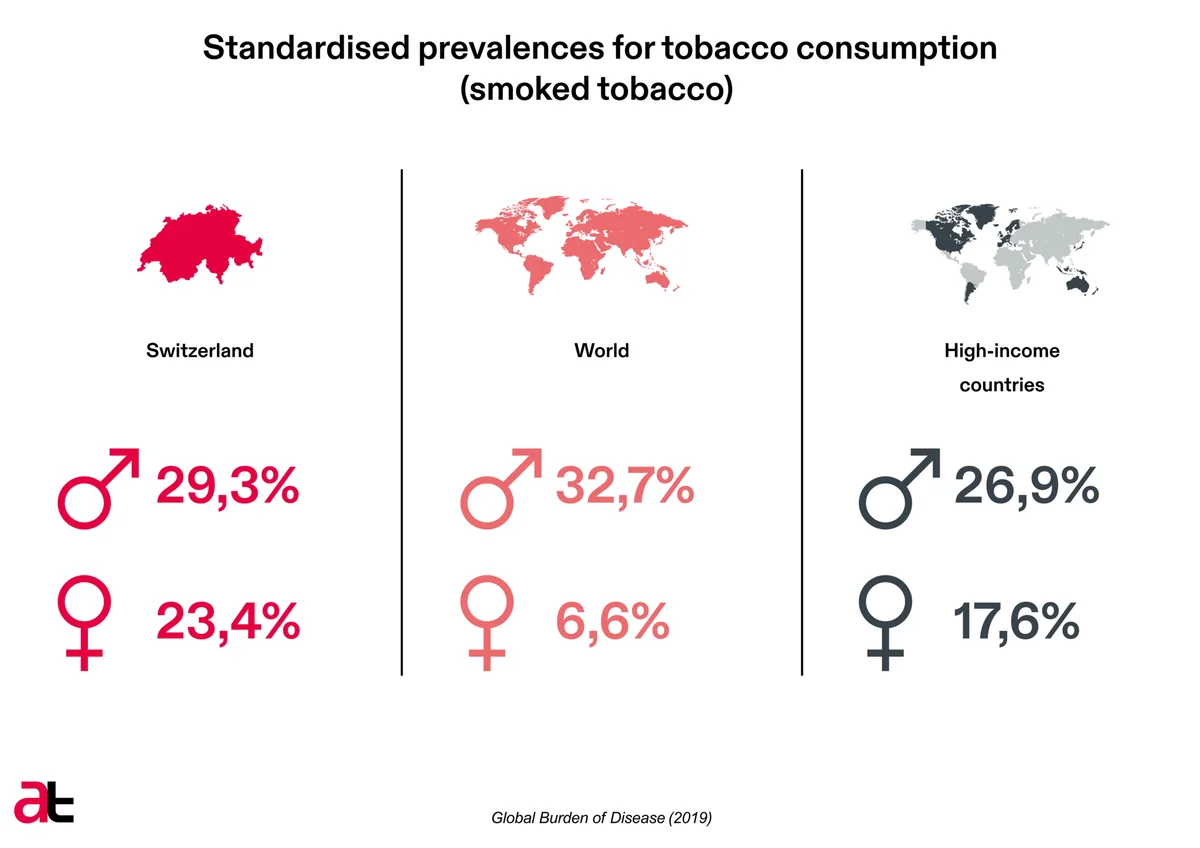
Figure 1: Standardised prevalence of tobacco use (smoked tobacco) worldwide, in high-income countries and in Switzerland, 2019 (Global Burden of Disease 2019) [9].
Smoking among 11- to 15-year-olds in Europe and Canada
Internationally, the HBSC survey was conducted in 2021/2022 in 44 countries, mainly in Europe (Cosma et al., 2024[11]). Based on data from all countries participating in this project, around 25% of 15-year-olds had already tried cigarettes (at least once in their lifetime; 24% of boys and 26% of girls), and 15% had smoked in the previous 30 days (15% of boys and 15% of girls; Charrier et al., 2024[12]). As described in our overview of smoking among 11- to 15-year-olds in Switzerland (see our page on tobacco use among young people), similar prevalence levels were observed for current use among 15-year-olds in Switzerland. According to HBSC data standardised for international comparison, cigarette use in the previous 30 days concerned 13% of boys and 16% of girls aged 15 in Switzerland. Experimental use (i.e. having smoked at least once in one’s lifetime) was, however, considerably more frequent in Switzerland than across the HBSC sample as a whole (Swiss data standardised for international comparison: 31% of girls and 30% of boys).
Other estimates and comparisons relating to smoking among young people
In its projections for the period 2020 to 2025, WHO reported – based on data from the HBSC studies, the Global Youth Tobacco Survey[13] (GYTS) and the Global School-based Student Health Survey[14] (GSHS) – that, worldwide, 10% of young people aged 13 to 15, or more than 40 million young people, smoke tobacco products in one form or another (World Health Organization, 2025[8]). In addition, according to these estimates, around 3.4% of young people in this age group – 4.0% of boys and 2.8% of girls – used smokeless tobacco products, representing more than 10 million young people aged 13 to 15 worldwide.
Comparisons with countries considered exemplary in tobacco control
Finally, while the European Parliament committed in 2022 to achieving a tobacco-free generation in Europe by 2040, countries such as Australia, New Zealand, Ireland, England, Finland and the Netherlands have developed exemplary tobacco prevention policies in recent years or decades. They therefore provide useful points of comparison for Switzerland, which is among the lowest-ranked countries internationally in terms of tobacco control measures (see our Tobacco Control Scale page).
Using the standardised estimates from the Global Burden of Disease (GBD 2019 Tobacco Collaborators, 2021[9]), Switzerland, with smoking prevalence of 23.4% among women and 29.3% among men, clearly exceeded Finland (women = 18.1%; men = 24.8%), the Netherlands (women = 20.4%; men = 25.0%), Ireland (women = 22.8%; men = 21.9%) and Great Britain (women = 18.1%; men = 21.7%). New Zealand (women = 15.2%; men = 18.4%) and Australia (women = 14.4%; men = 16.4%) had much lower adjusted prevalence levels.
Based on the HBSC 2021/2022 data (Charrier et al., 2023[12]), with 31% of girls and 30% of boys aged 15 having already tried cigarettes at that age (at least once in their lifetime), Switzerland was close to Finland (girls = 29%; boys = 29%), a country that nevertheless showed substantial decreases in prevalence in 2018 and 2022 compared with previous survey waves. Switzerland nevertheless performed clearly less well than Ireland (girls = 15%; boys = 12%), England (girls = 28%; boys = 16%) and the Netherlands (girls = 25%; boys = 22%).
[1] https://www.healthdata.org/research-analysis/gbd; accessed 13.02.2026.
[2] https://www.thelancet.com/gbd; accessed 13.02.2026.
[3] https://www.hbsc.org; accessed 13.02.2026.
[4] https://www.hbsc.ch; accessed 13.02.2026.
[5] GBD 2021 Tobacco Forecasting Collaborators (2024) Forecasting the effects of smoking prevalence scenarios on years of life lost and life expectancy from 2022 to 2050: a systematic analysis for the Global Burden of Disease Study 2021 The Lancet Public Health. 2024; 9(10):e729-e744.
[6] Cai, Y., Chen, G. and Bai, P. (2025) Global, Regional, and National Burden of Smoking-Related Diseases and Associations With Health Workforce Distribution, 1990–2021: Analysis From the Global Burden of Disease Study 2021. Int. J. Public Health 70:1608217.
[7] World Health Organization (2025). WHO global report on the global tobacco epidemic, 2025 : warning about the danger of tobacc. Geneva: World Health Organization. Download.
[8] World Health Organization (2025). WHO global report on trends in prevalence of tobacco use 2000-2024 ans projections 2025-2030. Geneva: World Health Organization. Download.
[9] GBD 2019 Tobacco Collaborators (2021). Spatial, temporal, and demographic patterns in prevalence of smoking tobacco use and attributable disease burden in 204 countries and territories, 1990–2019: a systematic analysis from the Global Burden of Disease Study 2019. Lancet. 2021 397: 2337-2360.
[10] World Health Organization (2021). WHO Report on the global tobacco epidemic 2021 - Addressing new and emerging products. Geneva: World Health Organization. Download.
[11] Cosma, A., Abdrakhmanova, S., Taut, D., Schrijvers, K., Catunda, C., and Schnohr, C. (2023). A focus on adolescent mental health and well-being in Europe, central Asia and Canada Health Behaviour in School-aged Children international report from the 2021/2022 survey. Volume 1. Copenhagen: WHO Regional Office for Europe. Download.
[12] Charrier L, van Dorsselaer S, Canale N, Baska T, Kilibarda B, Comoretto RI et al.., editors. (2020b). A focus on adolescent mental health and well-being in Europe, central Asia and Canada Health Behaviour in School-aged Children international report from the 2021/2022 survey. Volume 3. Copenhagen: WHO Regional Office for Europe. Download.
[13] https://www.who.int/teams/noncommunicable-diseases/surveillance/systems-tools/global-youth-tobacco-survey; accessed 13.02.2026.
[14] https://www.who.int/teams/noncommunicable-diseases/surveillance/systems-tools/global-school-based-student-health-survey; accessed 23.02.2022.
AT Switzerland, February 2026