Trends over the past 30 years
- Smoking increased substantially during the 1990s, then declined gradually but unevenly from the early 2000s onwards. It nevertheless remains at a level considered high.
Several studies provide insight into smoking trends in Switzerland. However, only one survey covering the adult population is still active: the Swiss Health Survey (SHS). Conducted since 1992, the SHS is limited primarily by the fact that it takes place only every five years, making it impossible to track smoking trends in Switzerland continuously. The long interval between SHS measurements also makes it difficult to determine whether changes between survey waves reflect genuine trends or temporary fluctuations, for example those influenced by the particular context of a given survey year. Trends outside the period from 2001 to 2016 must therefore be interpreted with caution. During that period, the surveys conducted as part of Tobacco Monitoring Switzerland (TMS; Keller et al., 2011[1]) and Swiss Addiction Monitoring (SAM[2]) were still running.
Trends since the 1990s
The Swiss Health Survey has tracked tobacco use among the population aged 15 and over since 1992. Smoking prevalence increased between 1992 and 1997, followed by two periods of slight decline: one between 1997 and 2007 and another between 2012 and 2022. These broad trends were observed among both men and women, although the gap in prevalence between them has narrowed substantially since the early 1990s.
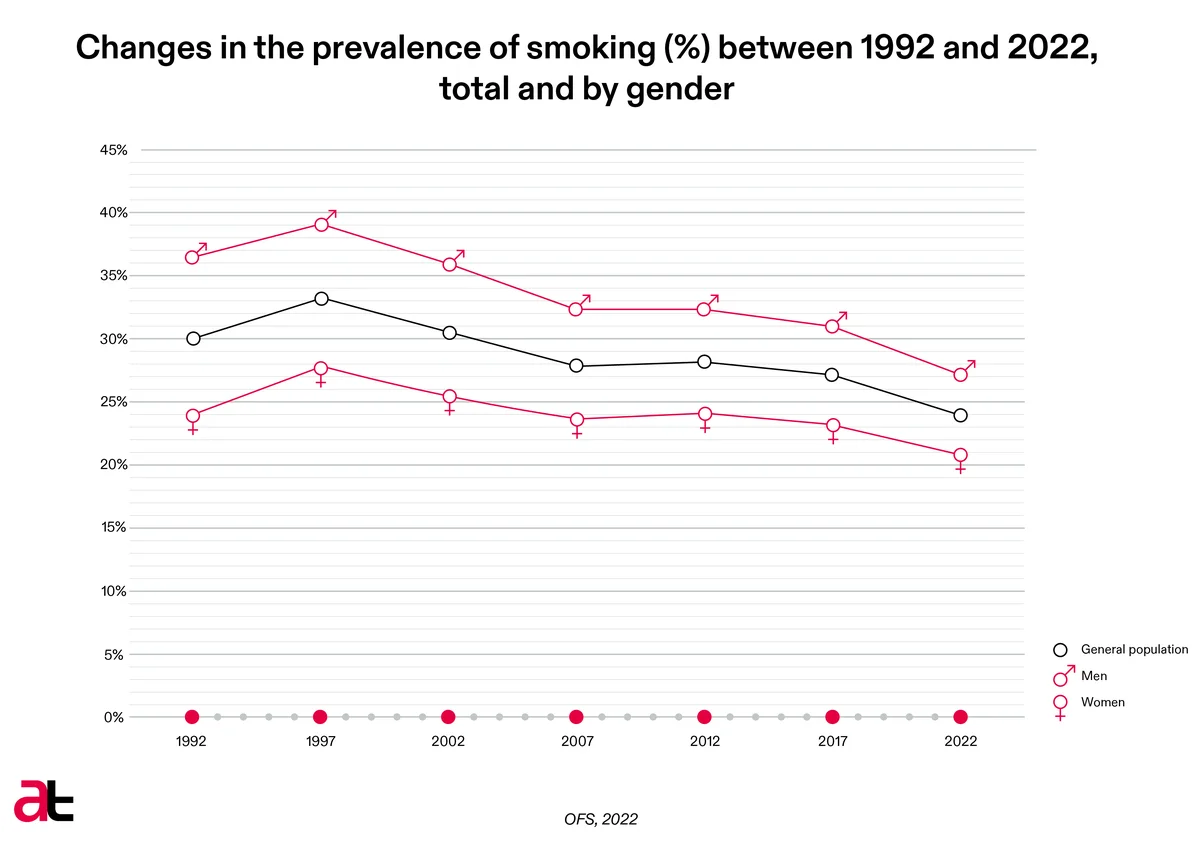
Figure 1 – Change in smoking prevalence (%) between 1992 and 2022, in total, by gender and by linguistic region, ESS 1992 to 2022 (Source OFS, 2023[3]).
Trends over this period nevertheless differed between the country's language regions and age groups. In Italian-speaking Switzerland, for example, trends appeared to follow those in the other language regions until 2007, but the proportion of people who smoked then increased between 2007 and 2017. Over the same period, smoking prevalence in German-speaking Switzerland first declined and then levelled off, while in French-speaking Switzerland a slight increase in 2012 was followed by a return in 2017 to a level comparable with that of 2007. All three language regions recorded a downward trend between 2017 and 2022.
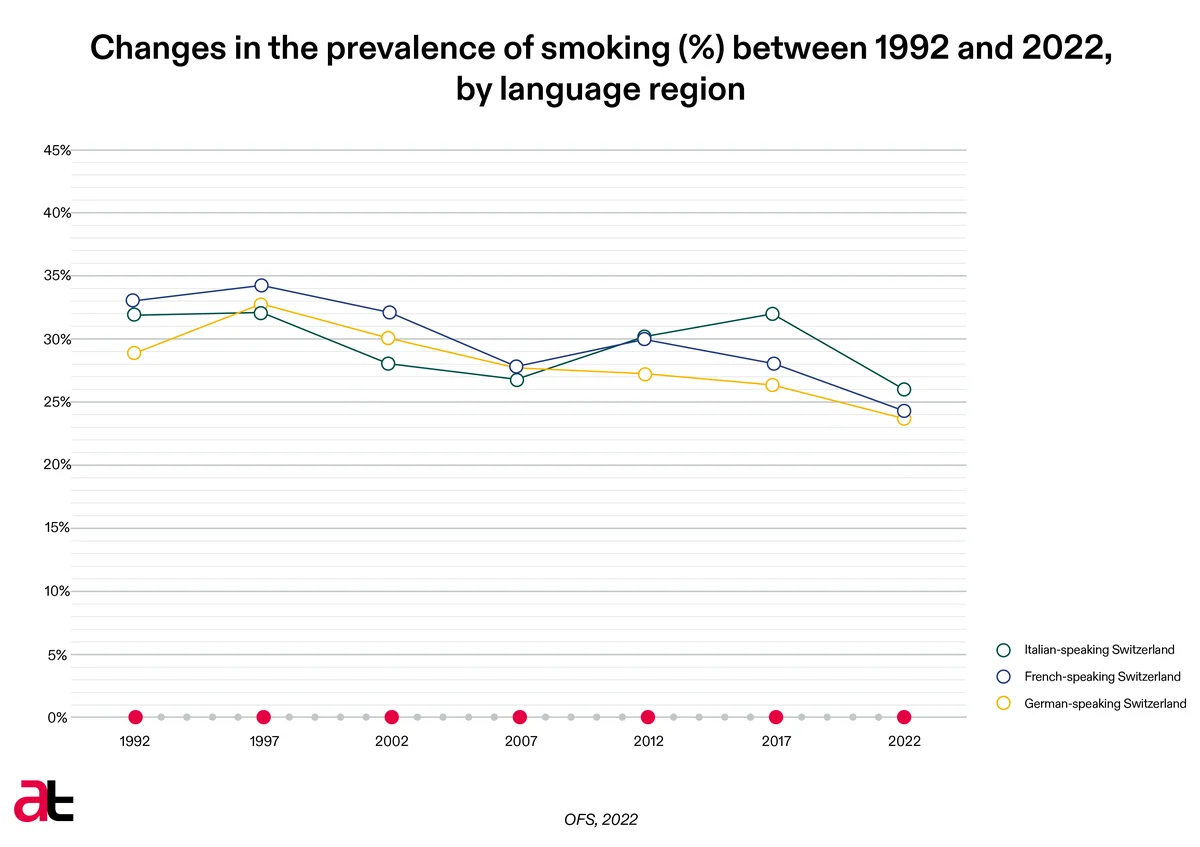
Figure 2 – Change in smoking prevalence (%) between 1992 and 2022, by linguistic region, ESS 1992-2022 (Sources OFS, 20234]).
Trends since the early 2000s
Between 2001 and 2016, two annual surveys dedicated to monitoring smoking behaviour followed one another: Tobacco Monitoring Switzerland (TMS), conducted from 2001 to 2010, and the Continuous Rolling Survey of Addictive Behaviours and Related Risks (CoRolAR), part of Swiss Addiction Monitoring, conducted from 2011 to 2016. As some aspects of the TMS and CoRolAR data-collection methods were similar, prevalence estimates from the two studies can be compared, although caution is required. In particular, their reference populations differed slightly: TMS covered people aged 14-65, whereas CoRolAR covered those aged 15 and over.
With these considerations in mind, the surveys suggest a continuous and steady decline in smoking prevalence between 2001 and 2008, from 33% to 27%, followed by a prolonged period of stagnation with slight fluctuations (Kuendig et al., 2012[4]).
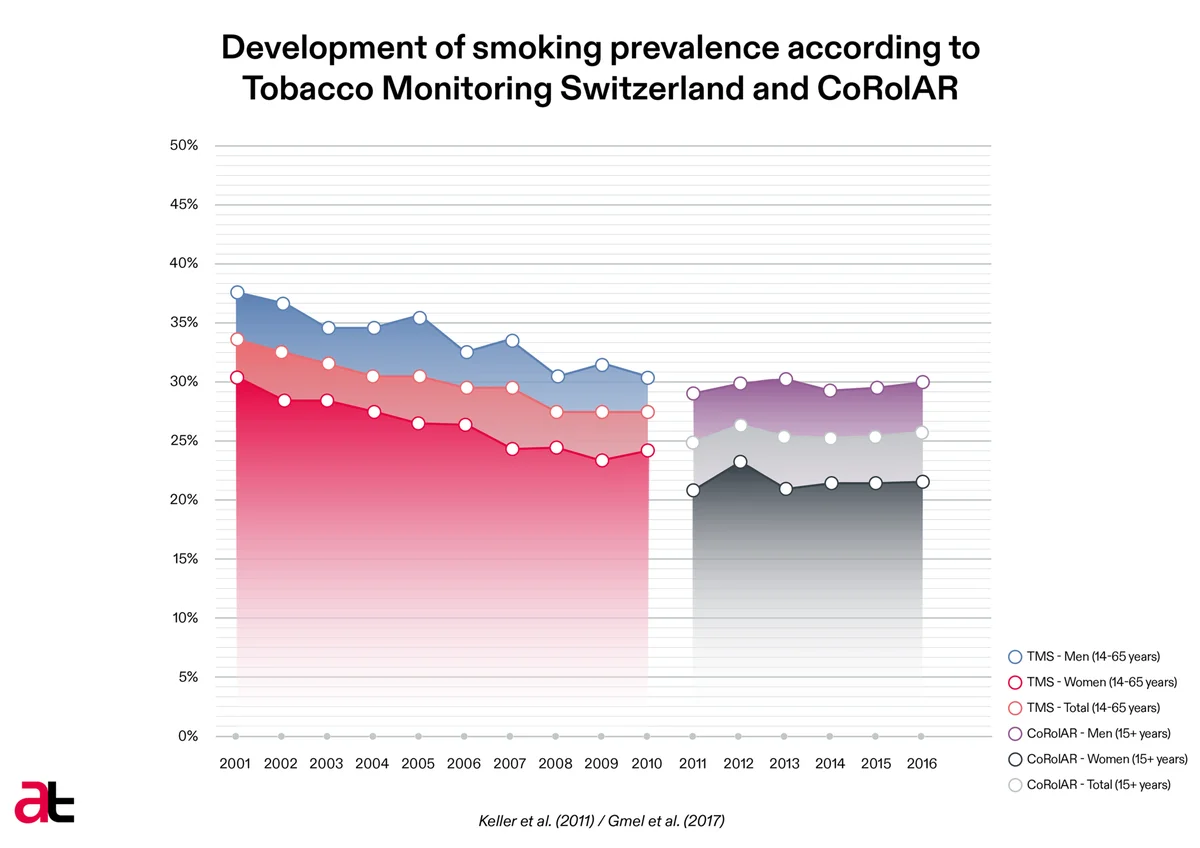
Figure 3 – Changes in the prevalence of smoking (%) based on the Monitorage sur le tabac Suisse 2001-2010 and the CoRolAR 2011-2016 studies (Sources Keller et al., 2011[6] and Gmel et al., 2017[7]).
The decline observed in TMS between 2001 and 2008 appears to have been driven mainly by a fall in daily smoking, from 24% to 19% of the population. The proportion of occasional smokers remained relatively stable throughout the period covered by TMS, from 2001 to 2010 (Keller et al., 2011[5]). The decline in smoking prevalence up to 2008 across Switzerland was also apparent in each language region, although it was slightly less pronounced in Italian-speaking Switzerland than elsewhere.
Combined analyses based on the available data sources
Combined longitudinal analyses of data from three surveys — the Health Behaviour in School-aged Children (HBSC) study, conducted every four years since 1986 among school pupils aged 11-15; the SHS; and the CoRolAR survey from Swiss Addiction Monitoring — found that changes in tobacco use in Switzerland over time, between 1992 and 2016, and across ages 15-89 broadly reflect what the international literature describes as the 'smoking epidemic'[7][8] (Gmel et al., 2018[9]). Under this model, smoking began and spread more rapidly among men, so peaks in prevalence occurred earlier among men than women. Similarly, after the peak, smoking prevalence would generally begin declining earlier among men. According to this theory, women follow the same pattern 10 to 30 years later, through the successive phases of rising prevalence, stabilisation, and decline.
[1] Keller, R., Radtke, T., Krebs, H., Hornumg, R. (2011). La consommation de tabac de la population suisse entre 2001 et 2010 - Résumé du rapport de recherche 2011. Universität Zürich. Zürich. Download.
[2] https://www.suchtmonitoring.ch/fr/page/8.html; consulted on 30.04.2026.
[3] https://www.bfs.admin.ch/bfs/fr/home/statistiques/sante/enquetes/sgb.assetdetail.28725086.html; consulted on 30.04.2026.
[4] Kuendig, Hervé; Georges, Aurélien; Notari, Luca (2012): Comparaison de résultats du Monitorage sur le Tabac Suisse 2010 et de l’enquête CoRolAR 2011. Sucht Schweiz. Lausanne. Download.
[5] Keller, Roger; Radtke, Theda; Krebs, Hans; Hornung, Rainer (2011): Der Tabakkonsum der Schweizer Wohnbevölkerung in den Jahren 2001 bis 2010. Tabakmonitoring - Schweizerische Umfrage zum Tabakkonsum.
[6] Gmel, Gerhard; Kuendig, Hervé; Notari, Luca; Gmel, Christiane (2017): Monitorage suisse des addictions Consommation d’alcool, de tabac et de drogues illégales en Suisse en 2016. Sucht Schweiz. Lausanne. Download.
[7] Lopez, Alan D.; Collishaw, Neil E.; Piha Tapani. A descriptive model of the cigarette epidemic in developed countries. Tob Control. 1994;3:242–7.
[8] Thun, Michael; Peto, Richard; Boreham, Jillian; Lopez, Alan D. Stages of the cigarette epidemic on entering its second century. Tob Control. 2012;21:96–101.
[9] Gmel, Gerhard; Notari, Luca; Gmel, Christiane. (2018): Rauchen und Alkoholkonsum in der Schweiz: Trends u?ber 25 Jahre, Kohorteneffekte und aktuelle Details in Ein-Jahres-Altersschritten – eine Analyse verschiedener Surveys. Sucht Schweiz. Lausanne. Download.
AT Switzerland, April 2026