Smoking among women in Switzerland: an epidemiological perspective
More than one in five women smoke
Linguistic, geographic and socioeconomic disparities
School-based surveys: one in thirty 15-year-old schoolgirls smokes daily
Gender differences have been narrowing for several decades
Young women are more likely to smoke than young men
Level of tobacco consumption among women who smoke
Types of tobacco products consumed by women in Switzerland
School-based surveys: types of products used by schoolgirls
More than one in five women smoke
- In Switzerland in 2022, more than one in five women aged 15 and over smoked (20.8%).
- Women under 45 are more affected by smoking than older women.
- Among 15- to 24-year-olds, smoking prevalence is currently higher among women (26.2%) than among men (25.4%).
According to the Swiss Health Survey (OFS, 2023[1]), smoking affects more than one fifth of the female population. However, the proportion of women who smoke varies considerably between population subgroups, particularly by age, but also according to other sociodemographic and economic characteristics.
In 2022, across all age groups, just over one in five women aged 15 or over — 20.8% — smoked, compared with 27.1% of men (Figure 1). Smoking is not evenly distributed across the female population. Younger age groups are particularly affected. Smoking prevalence is highest among women aged 15 to 24, reaching 26.2% (among men, the 35-44 age group is most affected by smoking). Although slightly lower, the proportion was still close to 25% among women aged 25-34 (24.6%) and 35-44 (24.3%). Among women of working age, the lowest proportion of smokers was found among those aged 45-54, although one in five women in this age group (20.1%) still smoked. The proportion then rose again among women aged 55-64 (22.9%).
An observation that is rare enough to be highlighted is that the 2022 Swiss Health Survey data suggest that, among 15- to 24-year-olds, the proportion of women who smoke — 26.2% — currently exceeds the proportion of men who smoke — 25.4%. From an epidemiological perspective, this is relatively unusual.
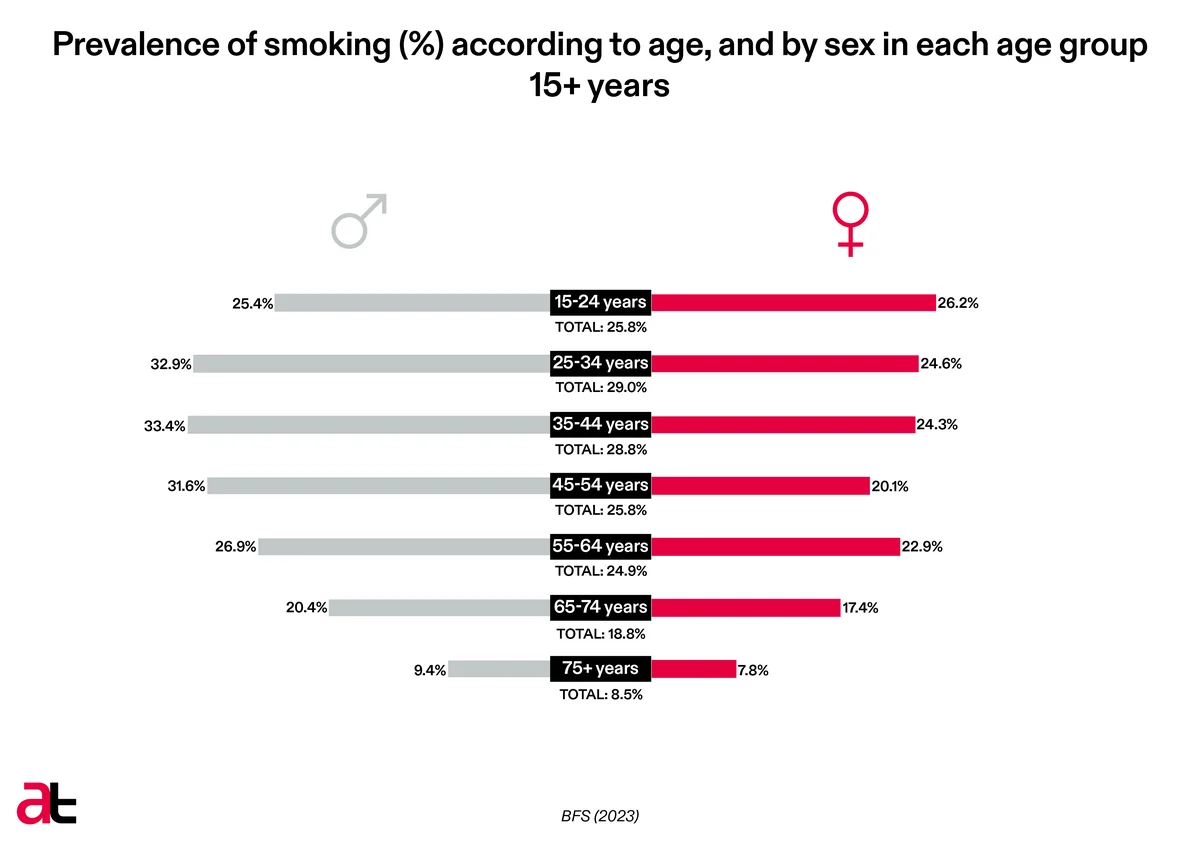
Figure 1 – Smoking prevalence (%) among women and men, overall and by age, Swiss Health Survey 2022 (OFS, 2023[1]).
Linguistic, geographic and socioeconomic disparities
Based on the 2022 Swiss Health Survey data, variations can be observed between linguistic regions in the extent of smoking among women (OBSAN, 2026[2]; Figure 2). Italian-speaking Switzerland had a higher proportion of women who smoke (24.3%) than French-speaking Switzerland (22.6%) and German-speaking Switzerland (19.9%). At cantonal level, prevalence above 25% was recorded only in the canton of Geneva. However, the proportion of women who smoke was above the national level — 20.8% — in the following cantons: Ticino (24.6%), Basel-Stadt (24.5%), Thurgau (24.4%), Valais (22.5%), Vaud (22.0%) and Aargau (21.5%). Conversely, the cantons of St. Gallen, Nidwalden, Schwyz, Zurich, Lucerne, Basel-Landschaft and Graubünden had smoking prevalence rates among women below 20%. Zug recorded the lowest proportion of women who smoke across all age groups considered, at 14.5% (OBSAN, 2026[2]). Also based on the 2022 Swiss Health Survey, differences were observed by type of residential area: across all linguistic regions and cantons, smoking prevalence was slightly higher among women living in urban areas (21.5%) than among those living in rural (19.6%) or intermediate areas (19.6%). However, these differences did not reach statistical significance.
The 2022 Swiss Health Survey data also show variations in smoking among women according to socioeconomic criteria, namely nationality, whether or not a woman is engaged in paid employment, and level of education (Figure 2). While the proportion of women who smoke reached 22.8% among women of other nationalities, it was 20.2% among Swiss women (a difference that was not statistically significant). Being economically active (i.e. engaged in paid work) was more strongly associated with a higher proportion of women who smoke (23.0% versus 17.1% among economically inactive women; a statistically significant difference). Relatively substantial differences were also observed among women aged over 25 by level of education: women who had completed upper-secondary education at most (22.5%) and, to a lesser extent, those who had completed compulsory schooling (19.8%) had higher smoking rates than women who had completed higher vocational education or university-level education (17.2%).
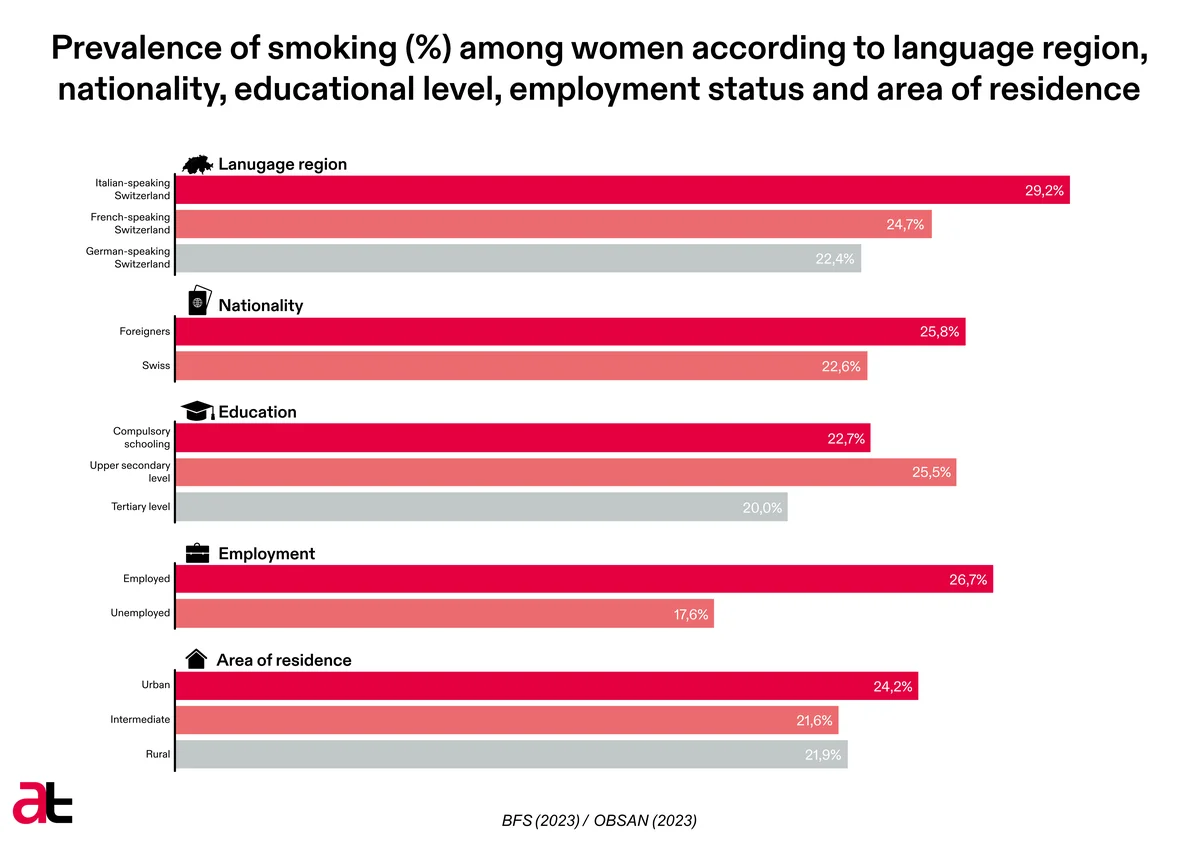
Figure 2 – Smoking prevalence (%) among women by linguistic region, nationality, level of education and economic activity, Swiss Health Survey 2022 (OBSAN, 2026[2]).
School-based surveys: one in thirty 15-year-old schoolgirls smokes daily
- At age 15, nearly one in thirty girls smokes daily (3.1%), and around one in three girls overall (31.0%) has already “experimented” with cigarettes.
The smoking figures from the HBSC survey (Delgrande et al., 2023[3]) show that, in 2022, 3.1% of 11-year-old girls had already experimented with cigarettes (having smoked at least once in their lifetime), and that this proportion increased considerably with age, reaching 31.0% at age 15. Cigarette use in the 30 days preceding the survey followed a similar pattern, with 16.6% of 15-year-old girls reporting having smoked during that period. Finally, although daily cigarette use remained virtually non-existent below the age of 13, it already affected 0.5% of 13-year-old girls, 1.5% of 14-year-old girls and 3.1% of 15-year-old girls. In other words, in Switzerland in 2022, nearly one in thirty 15-year-old girls smoked daily.
Gender differences have been narrowing for several decades
- During the 1990s, smoking increased markedly among women — even more than among men. It has declined since then, but less sharply among women than among men.
- Gender differences have been narrowing continuously for more than thirty years.
The Swiss Health Survey has monitored trends in tobacco use among people aged 15 and over since 1992. Among women, smoking prevalence increased between 1992 and 1997 (+3.7 percentage points). This was followed by a period of slight decreases between 1997 and 2007 (-2.3 percentage points in 2002; -1.9 percentage points in 2007), then a period of relative stagnation between 2007 and 2017 (+0.6 percentage points in 2012; -0.9 percentage points in 2017), before a more substantial decrease in 2022 (-2.5 percentage points; Figure 3). Although these overall trends broadly mirror those observed among men, the Swiss Health Survey data show that the prevalence gap between men and women has narrowed continuously since the early 1990s.
A secondary analysis published in 2018 (Gmel et al. 2018[4]) considered several available data sources together (the Swiss Health Survey, as well as data from the Health Behaviour in School-aged Children project and the Swiss Addiction Monitoring system). It concluded, among other things, that across all age groups, the development of tobacco use in Switzerland between 1992 and 2016 broadly reflected what the international literature describes as the “smoking epidemic” [5],[6]. According to this concept, because smoking began and increased earlier and more rapidly among men, higher prevalence peaks are observed earlier among men than among women. Similarly, after a peak has been reached, the decline in smoking prevalence is generally expected to occur earlier among men than among women. According to this theory, women follow men 10 to 30 years later, both in the phase during which smoking increases and in the subsequent phases of stabilisation and decline.
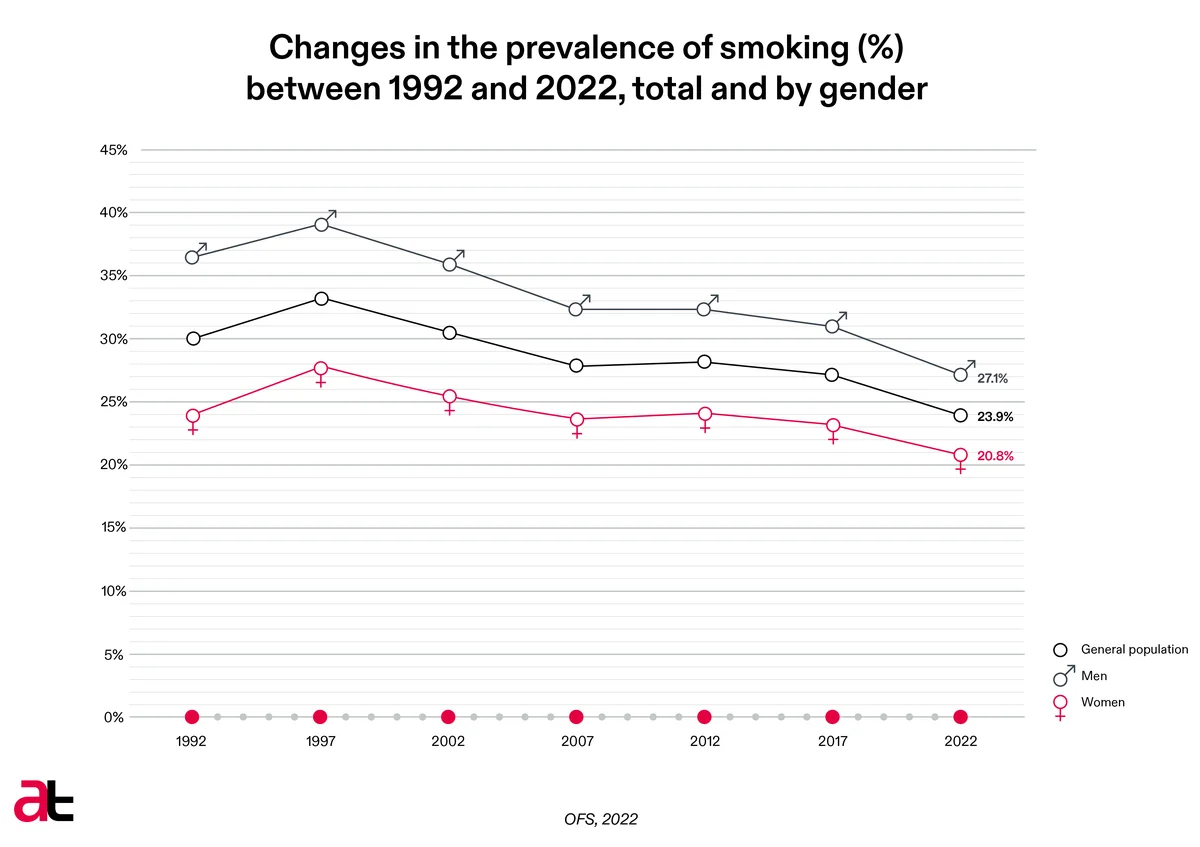
Figure 3 – Trends in smoking prevalence (%) between 1992 and 2022, overall, by sex and by linguistic region, Swiss Health Survey 1992-2022 (OFS, 2023[1]).
Young women are more likely to smoke than young men
As mentioned above, the 2022 Swiss Health Survey shows that among 15- to 24-year-olds, the proportion of women who smoke — 26.2% — currently exceeds the proportion of men who smoke — 25.4%. From an epidemiological perspective, this is a relatively unusual finding. It is rooted in different trends in smoking among women and men in this age group. While there has been an overall narrowing of male-female differences in smoking since the Swiss Health Survey was first conducted in 1992, the 15-24 age group appears to be particularly affected by this phenomenon. In the first wave of the Swiss Health Survey, the male-female difference in this age group peaked at 10.3 percentage points (36.0% of men smoked, compared with 25.7% of women in 1992). After a marked increase in smoking prevalence among both men (+10.6 percentage points) and women (+14.8 percentage points) in this age group in 1997, smoking prevalence in both subgroups declined more or less steadily until 2022, but not at the same pace: -10.6 percentage points among men aged 15-24 over the period 1992-2022, compared with +0.5 percentage points among women in the same age group over the same period. Compared with the 25-34 and 35-44 age groups, smoking has declined much more markedly among men aged 15-24 than among their older counterparts since the prevalence peak observed in 1997. This pattern is not observed among women. Smoking among women aged 15-24 exceeds that among women aged 25-34 and 35-44. One plausible hypothesis is that the prevention measures implemented across Switzerland since the 1990s, which have mainly targeted the youngest population subgroups (i.e. minors and young adults), may have affected young men and young women differently, possibly due to other external or environmental factors, such as the marketing of tobacco products.
Level of tobacco consumption among women who smoke
- More than two thirds of women who smoke do so daily, representing around one in seven women in the overall population (14.0%).
With regard to the intensity and level of consumption, the currently available 2022 Swiss Health Survey results cover the proportions of people who smoke daily and occasionally (OFS, 2024[7]), the proportion of people in the overall population who consume a given average number of cigarettes per day (OFS, 2023[8]; OFS, 2024[9]), and the average number of cigarettes smoked per day, regardless of frequency of consumption (OFS, 2024[9]). Overall, an estimated 14.0% of women aged 15 and over smoke daily, while 6.8% of the female population smokes occasionally (OFS, 2024[7]). This means that more than two thirds of women who smoke do so daily. Daily smoking is most common among women aged 55-64 (17.7%) and 35-44 (15.6%). In terms of consumption levels, the 2022 Swiss Health Survey data show that 2.3% of women consume an average of one packet of cigarettes or more per day (compared with 6.1% of men; OFS, 2023[8]). The latest Swiss Health Survey data also show that women who smoke — whether daily or not — consumed an average of 7 cigarettes per day (compared with an average of 9 among men who smoke; OFS, 2024[9]). Secondary analyses produced for the Swiss Monitoring System on Addiction and Non-communicable Diseases (MonAM), based on the 2017 Swiss Health Survey data, show that just under one sixth (15.1%) of women who smoke consumed at least 20 cigarettes per day (OBSAN, 2026[10]). These data also show that the proportion of women who smoke and consume at least 20 cigarettes per day increases in steps with age: in 2017, this proportion was close to or below 10% among women who smoke under the age of 35, and around or above 20% among those aged between 35 and 74.
Types of tobacco products consumed by women in Switzerland
- Traditional cigarettes remain by far the most commonly consumed tobacco product among women who smoke in Switzerland.
- In 2022, 5.6% of women aged 15 to 24 used electronic cigarettes (ENDS), compared with 2.8% of the population aged 15 and over.
With regard to the types of tobacco products consumed, the most recent monitoring data broken down by sex in the 2022 Swiss Health Survey report the use of tobacco products and electronic cigarettes in the population as a whole, regardless of smoking status (OFS, 2024a[11]; OFS, 2024b[12]). These data show that cigarettes remain the dominant tobacco product used by women in Switzerland: 18.6% of women consume tobacco in this form (compared with 22.0% of men). The use of other products appears more marginal: 2.6% of women report using electronic cigarettes (ENDS), 2.2% heated tobacco products such as IQOS, 1.1% smoking waterpipe (shisha or hookah), 0.5% using snus, 0.5% cigarillos, 0.2% cigars and, finally, less than 0.1% pipe tobacco.
Looking at the three main products used among the female population — traditional cigarettes, electronic cigarettes and heated tobacco products — the highest prevalence of traditional cigarette use was recorded among women aged 15 to 24 (23.3%) and 25 to 34 (22.2%). Electronic cigarette use was clearly highest among 15- to 24-year-olds (5.6%), well above the 3.8% observed among 25- to 34-year-olds and the 3.4% observed among 35- to 44-year-olds. Use of heated tobacco products was highest among women aged 35 to 44 (3.4%), compared with 3.1% among those aged 25-34 and 1.9% among those aged 15-24 (OFS, 2024a[11]; OFS, 2024b[12]).
Additional data complementing those collected through the Swiss Health Survey are available from the FOPH Omnibus Health and Lifestyle survey[13]. These data, which provide details on the prevalence of use of different tobacco products (or similar products) among women living in private households in Switzerland, confirm the trends observed in the 2022 Swiss Health Survey: according to the 2025 data from this survey, 15.8% of women consume tobacco in the form of cigarettes (compared with 19.6% of men), 6.0% use electronic cigarettes (5.9% of men), and 3.7% use heated tobacco products (3.8% of men; OFSP, 2026[14]). With regard to daily use of these different products, the survey estimates that 9.5% of women smoke cigarettes daily (compared with 12.8% of men; OFSP, 2026[14]), 2.3% of women use electronic cigarettes daily (OFSP, 2026[14]; OBSAN, 2026[15]), and 2.4% of women use heated tobacco products daily (OFSP, 2026[14]; OBSAN, 2026[16]). Based on these data, the use of other tobacco products, such as snus, nicotine pouches and snuff, is extremely rare among women in Switzerland (OFSP, 2026[14]).
School-based surveys: types of products used by schoolgirls
- At age 15, 7.5% of schoolgirls use ENDS very frequently (on at least 10 days in the previous 30 days).
- Non-negligible proportions of 15-year-old girls also use other tobacco products, such as waterpipe and snus, as well as heated tobacco products (HTP).
In addition to questions on “traditional cigarettes”, the 2022 HBSC survey documented the prevalence of electronic cigarette (ENDS) use among schoolgirls aged 11 to 15 and, among 14- and 15-year-olds, the prevalence of heated tobacco product (HTP), waterpipe, snuff and snus use (Delgrande et al., 2023[3]).
In this survey, the prevalence of experimentation with, or lifetime use of, electronic cigarettes among schoolgirls reached 2.4% at age 11, 7.8% at age 12, 18.2% at age 13, 31.9% at age 14 and 40.1% at age 15. At each age, these prevalence rates were slightly lower among girls than among boys. ENDS use in the previous 30 days remained relatively limited among 11-year-old girls (1.1%) and 12-year-old girls (2.8%), but then increased rapidly: in 2022, 10.0% of 13-year-old girls, 19.1% of 14-year-old girls and 25.0% of 15-year-old girls reported ENDS use in the 30 days before taking part in the survey. A substantial proportion of girls aged 13 to 15 also reported having used ENDS on 10 days or more during the 30 days preceding the survey: 3.4% — more than one in 30 — at age 13, 5.9% — more than one in 17 — at age 14, and 7.4% — more than one in 14 — at age 15. It is also noteworthy that while boys consistently exceed girls in terms of experimentation prevalence, girls consistently exceed boys for such frequent use — 10 days or more — in the previous 30 days.
With regard to other tobacco products, the 2022 HBSC survey reports that 4.9% of 14-year-old girls and 8.0% of 15-year-old girls had smoked waterpipe at least once in the previous 30 days[18], that snus use concerned 4.2% of 14-year-old girls and 5.6% of 15-year-old girls[19], and that heated tobacco product (HTP) use in the 30 days preceding the survey concerned 2.4% of 14-year-old girls and 2.9% of 15-year-old girls[20].
[1] https://www.bfs.admin.ch/bfs/fr/home/statistiques/sante/enquetes/sgb.assetdetail.28725086.html; accessed 30.04.2026.
[2] https://ind.obsan.admin.ch/fr/indicator/monam/consommation-de-tabac-age-15; accessed 30.04.2026.
[3] Delgrande Jordan, Marina; Balsiger, Nora; Schmidhauser, Valentine. (2023). Consommation de substances psychoactives chez les 11 à 15 ans en Suisse - Situation en 2022 et évolution dans le temps - Résultats de l'étude Health Behaviour in School-aged Children (HBSC) (Rapport de recherche No 149). Lausanne: Addiction Suisse. Download.
[4] Gmel, Gerhard; Notari, Luca; Gmel, Christiane. (2018). Rauchen und Alkoholkonsum in der Schweiz: Trends über 25 Jahre, Kohorten Effekte und aktuelle Details in Ein-Jahres-Altersschritten – eine Analyse verschiedener Surveys. Sucht Schweiz. Lausanne. Download.
[5] Lopez, Alan D.; Collishaw, Neil E.; Piha Tapani. A descriptive model of the cigarette epidemic in developed countries. Tob Control, 1994;3:242–7.
[6] Thun, Michael; Peto, Richard; Boreham, Jillian; Lopez, Alan D. Stages of the cigarette epidemic on entering its second century. Tob Control. 2012;21:96–101.
[7] https://www.bfs.admin.ch/bfs/fr/home.assetdetail.30305684.html; accessed 30.04.2026.
[8] https://www.bfs.admin.ch/bfs/fr/home/statistiques/sante/enquetes/sgb.assetdetail.28845217.html; accessed 30.04.2026.
[9] OFS (2024). Actualité OFS - Enquête suisse sur la santé – La consommation de tabac de 1992 à 2022. OFS. Neuchâtel. Download.
[10] https://ind.obsan.admin.ch/fr/indicator/monam/tabac-nombre-de-cigarettes-fumees-par-jour-age-15; accessed30.04.2026.
[11] OFS (2024a). Tableaux standards: Consommation de produits tabagiques et de cigarettes électroniques (1 de 2). OFS. Neuchâtel. Download.
[12] OFS (2024b). Tableaux standards: Consommation de produits tabagiques et de cigarettes électroniques (2 de 2). OFS. Neuchâtel. Download.
[13] https://www.bag.admin.ch/fr/enquete-sante-et-lifestyle; accessed 30.04.2026.
[14] Données en voie de publication au moment de la rédaction du texte ; Disponibles à moyen terme sur la page dédiée au volet 2025 de l’enquête Santé et Lifestyle du site de l’Office fédéral de la santé publique : https://www.bag.admin.ch/fr/enquete-sante-et-lifestyle-2025 (accessed 30.04.2026).
[15] https://ind.obsan.admin.ch/fr/indicator/monam/consommation-de-cigarettes-electroniques-age-15; accessed 30.04.2026.
[16] https://ind.obsan.admin.ch/fr/indicator/monam/consommation-de-produits-du-tabac-a-chauffer-age-15; accessed 30.04.2025.
[18] https://www.hbsc.ch/fr/tableaux-standards/substance_use/thirty-day-prevalence-waterpipe.html; accessed 30.04.2026.
[19] https://www.hbsc.ch/fr/tableaux-standards/substance_use/thrity-day-prevalence-snus.html; accessed 30.04.2026.
[20] https://www.hbsc.ch/fr/tableaux-standards/substance_use/thirty-day-prevalence-heat-not-burn.html; accessed 30.04.2026.
AT Switzerland, April 2026