- 23.01.2026
- News
- Blog
2026: Europe raises taxes on tobacco and nicotine. Switzerland looks the other way.
In January 2026, the Director-General of the World Health Organization (WHO), Tedros Adhanom Ghebreyesus, issued a renewed and clear call for strengthening taxation on tobacco products, recalling that taxation remains one of the most effective public health levers. As he stated: « Health taxes are not a silver bullet, and they’re not simple. They can be politically unpopular and they attract opposition from powerful industries with deep pockets and a lot to lose, but many countries have shown that when they’re done right, they’re a powerful tool for health. »[i]
In this context, the beginning of 2026 is marked across Europe by a wave of tax increases affecting tobacco products and, increasingly, nicotine products. These measures are almost systematically justified by public health objectives, particularly reducing consumption, preventing initiation among young people, and reducing social health inequalities. Switzerland, once again, stands out as an exception. While discussions are underway on minimum tax increases, they already face strong opposition from the tobacco industry, which continues to mobilize its traditional arguments.
In January 2026, almost all of Europe strengthens tobacco and nicotine taxation.
Austria, Germany, France and Italy have all embarked on progressive, predictable and multi-year increases in tobacco and nicotine product taxation, in line with public health objectives.
In Switzerland, by contrast, low taxation — largely influenced by the interests of the tobacco industry — continues to seriously harm population health.
This article examines, country by country, the main fiscal developments in Europe concerning tobacco and nicotine products. All countries surrounding Switzerland — notably Austria, Germany, France, and Italy — have committed to a trajectory of progressive and sustained tax increases. In addition, countries long considered leaders in dissuasive tobacco taxation, such as Ireland, the United Kingdom, and Finland, continue along this path. More recently, less expected countries, particularly in the Balkans, have also begun strengthening their tobacco and nicotine taxation as part of efforts to reduce smoking, notably Croatia and Montenegro.
| Country | 1 pack of cigarettes (Marlboro Red) | 1 box of nicotine pouches (Zyn, Velo) | 1 pack of cigarettes for heated tobacco (Terea) |
|---|---|---|---|
| Germany | € 8.50-8.80 | € 6.00 – 6.50 | € 7.00 - 7.50 |
| Austria | € 6.50-6.90 | € 5.50 – 6.00 | € 6.50 – 7.00 |
| Finland | € 11.50 | € 7.00 – 7.50 | € 8.00 – 8.50 |
| France | € 13.00 - 13.50 | € 6.50 – 7.00 | € 8.50 – 9.00 |
| Irland | € 18.00 – 19.00 | € 8.00 – 9.00 | € 10.00 – 11.00 |
| Italy | € 6.80 | € 5.00 | € 5,50 |
| United Kingdom | £ 18.00 – 20.00 | £ 7.00 – 8.00 | £ 9.00 – 10.00 |
| Switzerland | CHF 9.00 | CHF 3.90 | CHF 8.50 |
Germany
In Germany, taxation of tobacco and nicotine products is being strengthened progressively through 2026 as part of the so-called tobacco tax modernisation reform.[ii] This reform aims to align the taxation of all nicotine-containing products, in order to reduce disparities between product categories and support public health objectives.
Traditional cigarettes are subject to regular excise duty increases, applied in successive stages. These increases, amounting to approximately 10 to 15 euro cents per pack depending on the year, continue through 2026 and result in a gradual and predictable rise in retail prices.[iii]
Heated tobacco products are now subject to significantly higher taxation than in the past, with an explicit convergence of their tax level toward that applied to conventional cigarettes. In 2026, the tax burden on heated tobacco sticks increases substantially, reducing the price advantage these products had previously enjoyed.
In addition, Germany was one of the first European countries to introduce a specific tax on e-cigarette liquids, whether or not they contain nicotine. This tax increases from €0.26 per millilitre in 2025 to €0.32 per millilitre in 2026, representing an increase of approximately €3.20 for a 10 ml bottle compared to the situation prior to the reform, when no such tax applied.
Overall, these developments reflect a clear intention on the part of the German authorities to treat all nicotine-containing products in a coherent manner, using taxation as a central lever to reduce financial accessibility—particularly for young people and new users—while providing a predictable fiscal framework in the medium term. It is therefore reasonable to expect Germany to continue along this path of tax increases for these products in 2027 as well.
Austria
In Austria, taxation of tobacco and nicotine products is being strengthened from 2026 onwards as part of a progressive reform extending through 2028. Traditional cigarettes are affected by an increase in excise duties from the beginning of the year, with a direct impact on retail prices.[iv]
At the same time, Austria is expanding its taxation to so-called alternative nicotine products. From spring 2026 onwards, nicotine pouches and e-liquids for electronic cigarettes will, for the first time, fall within the scope of taxation, while heated tobacco products will be subject to progressive increases similar to those applied to cigarettes.
These successive increases result in a continuous rise in prices. Based on estimates and market adjustments already observed, the price of a pack of cigarettes, which stood at around €6.20 to €6.50 in 2025, is expected to approach €7 in 2026 and reach approximately €7.50 to €8 by 2028, depending on the brand.
This evolution forms part of a strategy aimed at reducing the financial accessibility of tobacco and nicotine products, while progressively aligning Austrian taxation with European public health objectives.
France
In France, tobacco taxation remains a central instrument of public health policy, and this orientation is reaffirmed at the beginning of 2026. Cigarette prices increase once again on 1 January 2026, as a result of the combined effect of higher excise duties and their automatic indexation to inflation. Depending on the brand, increases amount to approximately €0.40 to €0.50 per pack, pushing the price of many packs beyond €12.50 and, in some cases, above €13.[v] The Marlboro Red pack, often used as a reference price for international comparison, will even rise to €13.50.[vi]
Despite successive increases in taxation, manufacturers continue to offer products priced around €11.50, resorting to a strategy of fiscal undershifting aimed at preserving the affordability of tobacco for price-sensitive consumers.[vii] This practice complicates the achievement of the objective pursued by the French authorities, namely the introduction of a minimum price close to €13 per pack, which appears difficult to attain before 2027.
The evolution of tobacco taxation in France forms part of a long-term trajectory defined by national tobacco control plans, which aim to achieve a sustained reduction in consumption by making tobacco increasingly less financially accessible, particularly for young people. The political objective, regularly reiterated by the French authorities, is to maintain high and continuous fiscal pressure on tobacco products beyond 2026, notably looking ahead to 2027.
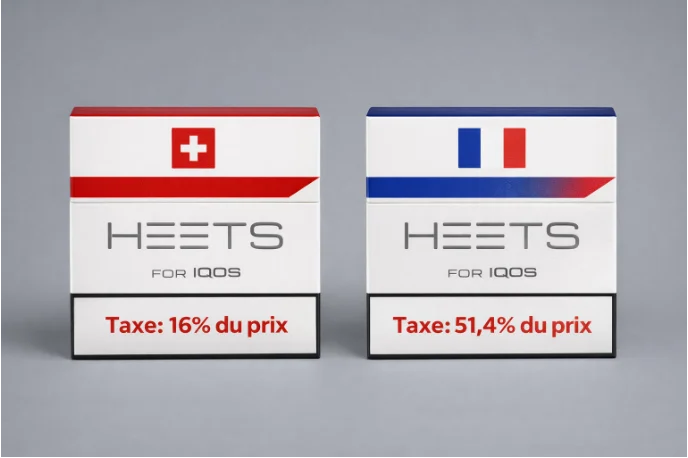
A pack of HEETS is sold in Switzerland and in France at virtually the same price, around €8.50–9.50.
But the difference in taxation between the two countries is enormous!
So, who pockets the difference? The tobacco industry.
With regard to so-called alternative nicotine products, the situation is more mixed. A proposal to introduce a tax on e-cigarette liquids was considered as part of the 2026 Finance Act, but it was ultimately not retained in the version adopted. E-liquids therefore remain subject to no specific excise duty in 2026, although the debate on their taxation remains open and could be revived in future budgetary discussions.
Overall, France is thus pursuing a strategy clearly oriented toward a structural and sustained increase in tobacco taxation, while moving more cautiously on the taxation of other nicotine products. This approach reflects a desire to consolidate the gains achieved in reducing smoking prevalence, while leaving open, for the years ahead, discussions on extending the fiscal framework to all nicotine-containing products.
In addition, despite criticism citing a potential increase in illicit or cross-border trade, France has also put an end to the fiscal exemptions previously applicable to tobacco in Corsica, thereby aligning tobacco prices on the island with those applied in the rest of the country.[viii] Since 1811, a Napoleonic decree had allowed the island to benefit from a derogatory tax regime, resulting in a reduction of approximately 25% in tobacco prices. This decision illustrates the French authorities’ determination to reduce territorial price disparities, which are regularly exploited by the tobacco industry to challenge tax increases and fuel arguments about parallel trade.
Italy
In Italy, prices of tobacco and nicotine products increase from the beginning of 2026 following new excise duty increases provided for under the Finance Act. This reform is part of a progressive fiscal strategy spanning several years, covering the period 2026–2028.[ix]
For traditional cigarettes, the increase in 2026 translates into an average rise of approximately €0.15 per pack compared to 2025. This increase is only a first step: additional hikes are already planned, amounting to around €0.25 in 2027 and €0.40 in 2028, which will lead to a noticeable and continuous increase in retail prices.
Roll-your-own tobacco is more heavily affected: the price of a standard 30-gram pouch increases by approximately €0.50 in 2026, reflecting a clear intention to reduce the price gap between different forms of tobacco consumption.
So-called “alternative” nicotine products, such as heated tobacco and electronic cigarettes, are also affected by the new excise duties. The increases applied to these products remain more moderate, resulting in price rises of only a few cents, but they nonetheless confirm a trend toward the gradual alignment of taxation across all nicotine-containing products.
In concrete terms, a pack of cigarettes sold at around €5.30 to €5.50 in 2025 reaches an average of €5.45 to €5.65 in 2026, then approximately €5.70 to €5.90 in 2027, before reaching nearly €6.10 to €6.30 in 2028, depending on the brand and price segment. These increases serve both budgetary objectives and public health goals, aiming to reduce the financial accessibility of tobacco products through regular, predictable, and phased tax hikes over time.
Ireland
In Ireland, tobacco taxation has long been used as a central public health lever, with a deliberate policy of regular, substantial, and predictable increases. The country now ranks among those with the highest tobacco prices in Europe, reflecting a long-term strategy explicitly aimed at reducing consumption and preventing initiation, particularly among young people.
As early as October 2025, this orientation was reaffirmed. Excise duties on cigarettes and roll-your-own tobacco were once again increased as part of the budget, leading to a further rise in retail prices. The price of a pack of cigarettes now far exceeds €15, with some brands reaching as much as €18.95.[x] These price levels reflect a clear political determination to maintain strong and continuous fiscal pressure, regardless of recurring criticisms related to cross-border or illicit trade.
Ireland is also pursuing an ambitious strategic vision, with the official objective of becoming a “smoke-free” country by 2035. In this context, taxation is conceived not as a one-off measure, but as a structural instrument intended to evolve regularly over time.
With regard to so-called alternative nicotine products, such as electronic cigarettes, Ireland does not yet apply, at this stage, a specific excise duty on e-liquids comparable to that introduced in the United Kingdom. Nevertheless, the debate is well underway at both political and administrative levels, particularly in light of growing concerns about vaping among young people. Several signals indicate that extending taxation to vaping products remains an open option for the coming years, in line with the overall approach to tackling nicotine dependence.
Overall, Ireland is pursuing a coherent, strict, and long-term trajectory in tobacco taxation. Given the clearly stated public health objectives and the relatively broad political consensus around the use of taxation as a deterrent tool, it is highly likely that this strategy will continue beyond 2026, including in 2027 and the years thereafter, both for combustible tobacco and potentially for other nicotine-containing products.
Finland
In Finland, taxes on tobacco and nicotine products increase significantly from 2026 onwards. Taxation of nicotine pouches rises by approximately 37%, pushing the price of a standard container from around €5 to nearly €7. At the same time, the average price of a pack of cigarettes stands at around €11.50, with more than 90% of this price consisting of taxes.
This reform forms part of a clearly defined fiscal trajectory: tobacco taxation continues to increase in semi-annual steps through mid-2027. This progressive approach responds to an explicit public health objective, aiming to sustainably reduce the financial accessibility of tobacco and nicotine products—particularly among young people—and to support a decline in their consumption.[xi]
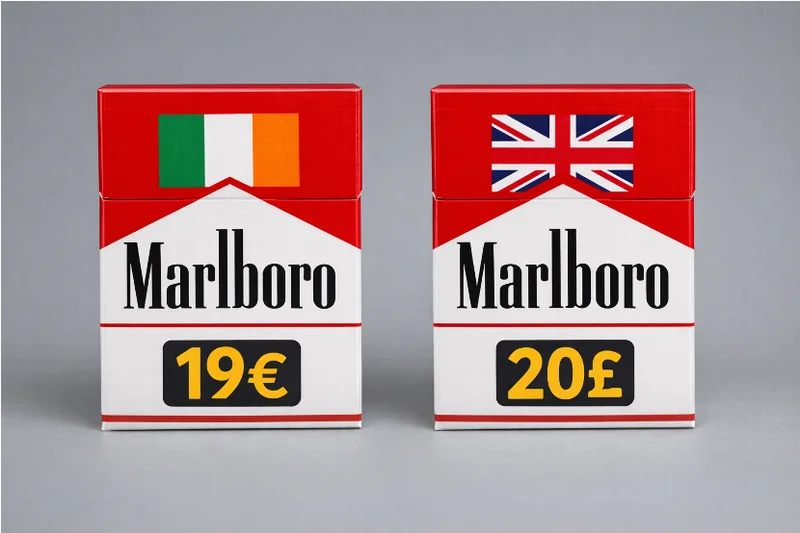
The European countries most advanced in tobacco control — with comprehensive and coherent policies — are Ireland and the United Kingdom, unlike Switzerland, which remains behind on these issues.
United Kingdom
In the United Kingdom, tobacco taxation has for many years been a central pillar of public health policy, based on a deliberate strategy of regular and predictable increases. Excise duties on cigarettes and roll-your-own tobacco are traditionally raised each year through an “escalator” mechanism, combining inflation with an additional increase designed to reduce consumption.
At the beginning of 2026, this approach continues: taxes on cigarettes and roll-your-own tobacco increase once again, resulting in a rise of several tens of pence per pack, consolidating price levels that are already among the highest in Europe.[xii] This development corresponds to an increase of more than 9.8% in the minimum excise rate in less than one year, an increase that is directly reflected in retail prices.
Available data already clearly illustrate the impact of these tax increases. In 2025, the average price of a pack of 20 cigarettes in the United Kingdom is generally estimated to be between £16 and £18, depending on brands and regions. Following the most recent excise duty increases, some analyses now place the average price of a pack at around £17.74, reflecting both the application of automatic excise increases and manufacturers’ anticipation of further hikes.
The outlook for 2026 confirms this upward trend. With the next increase scheduled for October 2026—combining indexation to inflation (RPI + 2%) and an additional increase of £2.20 per 100 cigarettes—several estimates indicate that the price of a pack could exceed £20, particularly for the most popular brands. By way of comparison, some international brands such as Marlboro already reached price levels between £18 and £20 in 2025, depending on the point of sale.
These increases take place within a clearly articulated political context. One of the explicit objectives of the UK government is to achieve a “smoke-free generation” by 2030, by combining taxation, regulation, and prevention measures. While taxation is not the only lever being used, it remains a central instrument of public health policy and is regularly presented as an effective means of reducing the financial accessibility of cigarettes and, in turn, lowering smoking prevalence.
At the same time, the United Kingdom is taking a major step in nicotine taxation by introducing, from 1 October 2026, a specific tax on e-cigarette liquids (the Vaping Products Duty).[xiii] This tax will take the form of a flat-rate levy of £2.20 per 10 ml, applicable regardless of whether the liquid contains nicotine. Including VAT, the resulting price increase will reach £2.64 per 10 ml bottle. The stated objective is twofold: to reduce the attractiveness of vaping among young people and non-smokers, while maintaining a deterrent price signal consistent with that applied to tobacco. Authorities estimate that approximately 5.1 million vapers will be affected. The measure is expected to generate £135 million in revenue in 2026–2027, rising to up to £565 million per year by 2030–2031, while also contributing to positive public health outcomes. CBD vaping liquids will also be subject to the tax. From April 2027 onwards, a mandatory duty stamp will be introduced to improve traceability and combat illicit trade.
Croatia
In Croatia, taxation of tobacco and nicotine products was significantly strengthened as of 1 January 2026, as part of a strategy aimed at progressively increasing tax revenues while pursuing explicit public health objectives.[xiv]
Excise duties on cigarettes have been increased across several components. The specific excise has been raised to €59.10 per 1,000 cigarettes, while the ad valorem component now amounts to 34% of the retail selling price. Most notably, the minimum excise level has been increased to €130.60 per 1,000 cigarettes, representing an increase of nearly 7% compared to the previous level. These mechanical adjustments result in a direct increase in retail prices.
In practice, this reform has led to an average price increase of around €0.20 per pack, corresponding to a rise of approximately 4% to 6% depending on the brand. Despite this increase, prices remain relatively low: a pack of cigarettes sold at around €4.80 to €5.30 in 2025 now reaches approximately €5.00 to €5.50 in 2026, a level still well below that observed in most Western European countries.
The reform is not limited to cigarettes. Roll-your-own tobacco and other smoking tobaccos are now taxed at €126.90 per kilogram, while heated tobacco products are subject to an excise duty of €211.30 per kilogram. E-liquids for electronic cigarettes are also subject to a new specific tax, set at €0.25 per millilitre, marking a clear break with the previous situation in which these products were little or not taxed.
According to government estimates, all of these increases are expected to generate more than €120 million in additional revenue in 2026. The authorities have nevertheless opted for a gradual increase, in order to limit disruptive effects while sending a clear price signal to consumers in a country where smoking prevalence remains high.
This development places Croatia on a path of European convergence, even though the country still remains well below the levels of taxation and prices observed in Western Europe. It nonetheless illustrates a clear determination to anchor tobacco and nicotine taxation in an upward and long-term trajectory.
Montenegro
In the Balkans, the increase in tobacco taxation is not limited to Croatia: Montenegro is also raising taxes, implementing a genuine strategy of progressive and long-term increases. From Monday, 19 January 2026, cigarette prices will rise by €0.20 to €0.50 per pack at retail outlets, following a new excise duty increase announced by the Ministry of Finance.[xv]
Depending on the brand and format, the new prices vary considerably. For example, some packs now reach €6, while other references are priced between €4 and €4.60. Entry-level cigarettes such as Winston will also see price increases, with packs sold between €3 and €3.80. As early as mid-December, the Ministry of Finance indicated that this increase corresponded to an average rise of around €0.20 per pack, or approximately 7.7%, directly linked to the increase in tobacco taxation.
This measure forms part of a long-term fiscal strategy: five additional similar increases are planned every six months until the end of 2028. Ultimately, the government expects the cheapest legally sold pack of cigarettes to cost more than €4. The stated objective is both budgetary and related to public health, by gradually reducing the financial accessibility of cigarettes through regular and predictable tax increases.
European Union: the path toward fiscal harmonisation of tobacco and nicotine taxation
At the level of the European Union, discussions on the fiscal harmonisation of tobacco taxation reached an important milestone in 2025 with the European Commission’s proposal to revise the Tobacco Taxation Directive (Directive 2011/64/EU), a framework that has remained unchanged for more than a decade. This revision aims to raise minimum excise rates, reduce price disparities between Member States, and extend taxation to all nicotine-containing products, including heated tobacco, e-liquids, and nicotine pouches.
The stated objective is twofold: to strengthen the effectiveness of taxes as a public health tool and to adapt taxation to rapid market developments, in line with Europe’s Beating Cancer Plan. The Commission emphasises that current disparities in taxation weaken the deterrent impact of prices and encourage cross-border purchasing.
However, the proposals are the subject of intense political debate within the Council and the European Parliament. While many public health actors support ambitious harmonisation, several Member States and the tobacco industry have expressed reservations, particularly regarding the pace and scale of the increases. At this stage, an entry into force around 2028 is being discussed, subject to the outcome of the ongoing legislative negotiations.
…and in the meantime, Switzerland remains lagging behind.
While the vast majority of European countries have embarked on—or continued—clear, progressive, and openly stated trajectories of increasing tobacco and nicotine taxation, Switzerland continues to stand out as a negative exception. Cigarette taxation has remained virtually unchanged since 2013, the result of persistent and organised opposition from the pro-tobacco lobby within Parliament. As for heated tobacco products, they still benefit from preferential tax treatment, with a tax rate of around 16%, which is largely insufficient given their risks and growing market penetration—almost exclusively to the benefit of the tobacco industry.
Since 2013, cigarette taxes in Switzerland have not increased by a single cent.
The situation is equally concerning with regard to nicotine products more broadly. Taxation remains weak, fragmented, and poorly structured, with no genuine public health strategy. Electronic cigarettes and vaping liquids long escaped any specific taxation, and the federal tax recently introduced remains modest and non-deterrent.
At a time when the European Union, neighbouring countries, and many comparable states are fully using taxation as a central public health tool, Switzerland persists in a minimalist approach that weakens its prevention policies and delays alignment with international standards. The question is therefore no longer whether an ambitious tax reform is necessary, but how much longer Switzerland will continue to yield to the harmful influence of the tobacco industry.
Luciano Ruggia, 23.01.2026
[ii] https://se-legal.de/tax-lawyers-germany/germany-tobacco-tax-laws-2022
[v] https://www.douane.gouv.fr/sites/default/files/2025-12/16/Maquette%20JORF%201er%20janvier%202026.pdf
[ix] https://tg24.sky.it/economia/2026/01/03/rincari-2026-aumenti-sigarette-autostrade-benzina?card=3
https://tg24.sky.it/economia/2025/10/29/aumento-sigarette-prezzi
https://www.unsertirol24.com/2025/12/14/ab-2026-wird-rauchen-teurer/
[x] https://tobaccoreporter.com/2025/10/09/ireland-increases-cigarette-prices
https://www.index.hr/vijesti/clanak/od-nove-godine-poskupljuju-cigarete/2745164.aspx
https://www.croatiaweek.com/croatia-tobacco-tax-increase-cigarettes-e-liquids/